

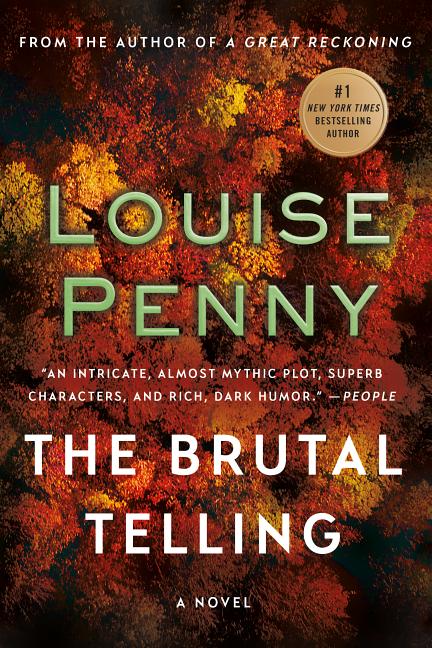
The Brutal Telling
by Louise Penny
 )
 )
Couldn't load pickup availability
The wise and beleaguered Chief Inspector Armand Gamache returns to Three Pines The Brutal Telling, the fifth book in Louise Penny's #1 New York Times bestselling series.
Chaos is coming, old son.
With those words the peace of Three Pines is shattered. Everybody goes to Olivier's Bistro—including a stranger whose murdered body is found on the floor. When Chief Inspector Gamache is called to investigate, he is dismayed to discover that Olivier's story is full of holes. Why are his fingerprints all over the cabin that's uncovered deep in the wilderness, with priceless antiques and the dead man's blood? And what other secrets and layers of lies are buried in the seemingly idyllic village?
Gamache follows a trail of clues and treasures—from first editions of Charlotte's Web and Jane Eyre to a spiderweb with a word mysteriously woven in it—into the woods and across the continent, before returning to Three Pines to confront the truth and the final, brutal telling.
*BONUS CONTENT: This edition of Brutal Telling includes a new introduction from the author and a discussion guide.
Share
Book Details
- ISBN
- 0312661681
- Binding
- Paperback
- Authors
- Louise Penny
- Publisher
- Minotaur Books
- Published Date
- August 31, 2010
- Language
- English
- Pages
- 400
- Physical Info
- 1.06 in H x 8.72 in L x 5.26 in W (0.81 lb)
Even though I knew how it ended because I had read the next in the series out of order, I still could not put it down! Ms. Penny weaves such an intricate tail with mysteries on many levels.
Many wonderful stories woven into this mystery! Keep learning more about all the characters who come to be in Three Pines
This novel, like Penny's others is full of mystery, warmth, and wisdom. When reading it one wishes to be part of the friendships and beauty surrounding the characters.
No matter how long it has been since my last read of a Gamache novel, sitting down with the next in this marvelous series is like wrapping myself in a blanket of familiarity. The steady pace and slow unraveling of these mysteries keeps me turning the pages, and I’m always surprised by how much more there is for me to learn about the world of Three Pines and history in general. I felt sad at the end of this particular book, but also anticipatory at how some of the changes will echo in future books.
Penny does not disappoint in the latest case for Inspector Gamache. With all the characters you know, this mystery will grab you literaaly in the first five pages!
- 5 stars: 17 (85%)
- 4 stars: 2 (10%)
- 3 stars: 0 (0%)
- 2 stars: 1 (5%)
- 1 star: 0 (0%)
Even though I knew how it ended because I had read the next in the series out of order, I still could not put it down! Ms. Penny weaves such an intricate tail with mysteries on many levels.
Many wonderful stories woven into this mystery! Keep learning more about all the characters who come to be in Three Pines
This novel, like Penny's others is full of mystery, warmth, and wisdom. When reading it one wishes to be part of the friendships and beauty surrounding the characters.
Penny does not disappoint in the latest case for Inspector Gamache. With all the characters you know, this mystery will grab you literaaly in the first five pages!
No matter how long it has been since my last read of a Gamache novel, sitting down with the next in this marvelous series is like wrapping myself in a blanket of familiarity. The steady pace and slow unraveling of these mysteries keeps me turning the pages, and I’m always surprised by how much more there is for me to learn about the world of Three Pines and history in general. I felt sad at the end of this particular book, but also anticipatory at how some of the changes will echo in future books.
I love a mystery - puzzle - where I learn more than police procedurals and back stories of conflicted, neurotic or bent detectives. In The Brutal Telling, we are treated by Louise Penny to Canadian and First Nations intertwined histories, First Nations’ art, art history, European history, fine craft history, and how artists’ fame and fall are made. Plus it was a damn good and challenging puzzle for Chief Inspector Gamache and me, as a binge-reader. On to Book 6!
I think this has been one of the better ones so far but, without giving anything away, I am a bit sad about the ending.
I have read 5 Louis Penny /Gamache novels. This one just wandered and at the end, I felt like the resolution was just because Gamache kept asking the same person questions over and over again. Everyone else's answers really did not reveal much. There were new stories and characters introduced in the last 2-3 chapters that randomly triggered Gamache to know the "truth" . The end had a very underwhelming resolution. There were also some random tangential stories meant to be more social commentary than I remember from past books, including a random bashing of Air Canada... which was really odd and out of place. She must have had a bad flight the day of writing that part of the book. ;-)SPOILER ALERT!!!! Stop reading if you don't want to know the end.Compounding the underwhelming resolution, I read about the next novel and the person they arrested for the murder in this book actually did not even commit the murder. So this book was apparently a total set-up for the next book. I suppose if you think of this book as being half of one book, maybe that makes this make more sense. But I will say that a major character in this book who does get arrested basically got arrested because he did some truly cruel and greedy S$#t to the victim. Yet, this character is apparently in many books following this, so perhaps this was just a set-up for a redemption story, but man, you would have to overlook a lot for this guy to keep him as a main part of your town.But bottom line, this is long read for a set-up. Only read this if you plan to read the next book... which I think I likely will not.
This one was sad and a cliffhanger. I loved the book. The next should have more personal changes to the CI's life.
Gamache carries Louise Penny’s deep wisdoms and shares them with us, the readers. It’s not about solving the whodunnits although that is part of the journey. She helps open us up to ourselves. Another wonderful tale.
As usual the characters and three pines glowed with warmth and the familiarity of a hug from a long lost friend. In addition the connection between humanity and art rang loud and clear till the very end Enjoyed immensely!
Louise brings Three Pines to life by revealing it's flaws thereby making it real and not just a snow globe village. Breaks the rules and breaks my heart but the plot and chsracters are as ususl cimplex and funny at the same time. I want ALL of them as my neighbors! Read on in the series if you want the telling to be a bit less " brutal"
I have read all 18 of these books and was very sad there weren’t more of this series. I impatiently await book 19 due out in October of this year. Some of these are free from Kindle if you have Amazon Prime and the rest were relatively inexpensive from the Amazon website. I would recommend it to men or women. The characters were amazing!
Another in the Inspector Gamache series, in which he is not only seeking the killer of a hermit, but also who the victim was, and why he had so many treasures from various European countries. Even a visit to Haida country in the Queen Charlotte Islands of BC doesn't provide all the answer sought--or does it?
The village of Three Pines in Quebec, close to the Vermont border, often seems lost in time. Even with an occasional murder investigated by Inspector Armand Gamache and his team from the Quebec Surete in Montreal, the basic fabric of life remains intact.The bistro, with its wonderful food, is the center of communal life. The used bookstore is filled with good books, advice, and the large presence of its owner, former psychologist Myrna Landers. The artists Peter and Clara Morrow continue to produce wonderful art, and Clara is anticipating her first major show. The eccentric and often vulgar poet Ruth Zardo maintains her policy of offending everyone while she dresses her duck Rosa in sweaters and coats.Yes, murders happen, but the fabric of life in Three Pines continues.But not this time. Not in the fifth of the Inspector Gamache mystery novels by Canadian writer Louise Penny, “The Brutal Telling.” This time, the world of Three Pines will be upended.A body is found early one morning in the bistro. It appears to be an elderly man who’s had his head bashed in. But there’s no blood, indicating the man was killed elsewhere.What the reader knows from the beginning is that Olivier Brule, the owner of the bistro, knows the murdered man’s identity, and has been visiting him at the man’s cabin deep in the nearby woods.The mystery of the man’s identity is compounded when the cabin is eventually discovered. Inside the cabin are priceless antiques, signed first editions of books, artifacts that went missing during World War II, and other treasures. Among all of these are small, exquisitely carved pieces of redwood, found only in British Columbia.Solving this mystery will indeed change Three Pines and the lives of the people who live there.“The Brutal Telling” is the fifth mystery in Penny’s Inspector Gamache series. The amazing thing is that, despite many of the same characters and same setting, each story is new, fresh, and different. And so far in the series, the stories are becoming better, more nuanced, and deeper. This story at times threatens to break out from the mystery genre and become serious literary fiction.Now I can’t wait to read the next in the series.
Book 5: Solitude, Friendship, SocietyI skipped over The Brutal Telling, Louise Penny's fifth Chief Inspector Gamache Book, due to some readers' reviews that described it as brutal in destroying their illusions about Three Pines. I read it after the next three novels in Penny's series--but, having read it, I disagree that this book made Three Pines and its residents less attractive. From the very first novel in this series, Still Life, Penny depicted the Three Pines residents as quirky and flawed. In The Brutal Telling, their moral struggles come to the forefront. Peter struggles with what to advise Clara and Clara with whether to defend a friend if doing so means risking her dreams. Ruth's impulse to make a wild animal even tamer goes to ridiculous lengths, which she seems not to recognize in spite of her poetic insights into other characters' struggles. Characters, including the Gilberts who are new to Three Pines, are called on profitting at others' expense. Olivier's greed and lies are the central moral issues in this novel, and the tale of the Mountain King is a powerful allegory about greed and trust. At crucial points, characters reflect on what they need to be happy, which must be a major issue for Penny as she brought many of these characters to Three Pines after less happy lives elsewhere.In fact--although this is a police procedural in terms of tracking down the clues and arresting a suspect--this book could be considered a Louise Penny treatise on solitude, friendship, and society (or withdrawal from society). Three Pines is not on any map and is described in many of these mysteries as being found by only those who need it, and they often need it in order to escape the rat race or troubled relationships. In most of Penny's mysteries, we learn a backstory that explains a character's flaws (perhaps ironic for an author who has one character, Myrna, abandon her career as a psychologist as unfulfilling) and also explains why Three Pines is a refuge for that person. For her most important Three Pines characters, Three Pines is like an intentional community set apart from the outside world. Penny explores intentional community more explicitly in The Beautiful Mystery; but here, in addition to Three Pines, she has Gamache visit a remote Haida community on Queen Charlotte Islands; she describes the greed that almost destroyed that society, as well greed as a destructive force in Three Pines and for the villagers in the allegorical Mountain King tale. Thoreau's quote about three chairs from Walden, "One for solitude, two for friendship, three for society." is included five times in The Brutal Telling. Besides The Hermit, at least three other characters are described as choosing a solitary or removed existence over family and friends. Gamache says he only needs a second chair for friendship, for his wife Reine-Marie, in order to be happy; but I think he is wrong--he has a talent for society, for fitting into and appreciating each of the set-aside groups that Penny has created in her mysteries as locales for his detective skills. The only group in which he cannot fit is the corrupt upper echelon of the Surete, where "society" already has been destroyed by greed and lies. Fortunately, that looming specter is absent from this particular novel.Louise Penny not only develops characters who become real and develop from book to book, she carries their stories over from one book to later books. I do not know whether she has planned what will happen over several books; but, looking back (easier with the Kindle versions), she has usually dropped hints earlier of developments to come. As with the surprises that change the meaning of Clara's paintings, many of these hints go against what we think we know about the characters but, when understood, change our perception permanently. For example, in Still Life, four books previously, Penny describes Olivier very positively but also mentions, "The greedy antique dealer in him, which composed a larger part of his make-up than he'd ever admit..." and "beside himself with lust after Jane's home. He'd kill to see beyond her kitchen door." It is not giving away anything to state that the backstory in The Brutal Telling is Olivier's history, which accounts for his lies and secretiveness, which ultimately threaten the community. There are many lessons to be learned from this book, as well as some light-hearted moments (a duck in a raincoat?) despite the serious issues.Along the way, The Brutal Telling also arouses readers' social conscience (mistreatment of native peoples, prejudice against gays) and educates us about literature (Thoreau), art (Emily Carr), and music (Martinu). Very worthwhile.
I've read five or six of Louise Penny's novels, and I've enjoyed all of them. The setting intrigues me; the characters make me laugh--often. The Brutal Telling seemed likely to be the best of the series--until the end of the book. Suddenly, Penny was summarizing events I wanted to witness first hand. Of course, the summaries left holes in the plot. What about the trial, anyway? And how did Peter respond to Clara's new sponsor? How could Gamache see the wrong person go to court? Olivier's father disappeared more quickly than the duck. No closure there.On the positive side, I love the poetry. I love the discussions of writing, art, storytelling, Canadian and other histories, and many other topics that Penny makes relevant. I'll read more of her novels because they're entertaining, but the ending should be written early on and shaped as the book flows. It's a big mistake to rush an ending or to think readers of cozies will be satisfied with anything but factual clarity as closure.As a miscellaneous note, I wish Penny's editor would get rid of at least half the fragments she writes. They are too cute. The duck is enough cute for one novel.
Be prepared for a late night from the moment you open "The Brutal Telling." Like most of Louise Penny's Inspector Armand Gamache series, this one will keep you turning pages in classic "can't put it down" mode. Penny's Three Pines, Quebec, the fictional village where many of her stories unfold, is not only believable but positively magnetic, as are the wonderfully interesting and multi-dimensional characters who live there. I've read most of the novels in the Gamache series, and "Brutal Telling" is one of the best. When the body of an unidentified old man is found in the cozy B&B operated by Gabri and his antique-dealer partner, Olivier, neither a suspect nor a motive is immediately apparent. That changes when the old man's remote cabin in the woods is discovered, and it's crammed with treasures, from priceless art to historic artifacts thought lost forever. Inspector Gamache realizes that many people in the picture-perfect village might have been willing to kill for such treasures.The best thing about this book, though (and the entire series, for that matter), is the brilliantly drawn Gamache himself. Gamache is, in my view, the most fascinating and appealing protagonist in contemporary murder mysteries. He is a kind and gentle man, a student of history, a lover of literature. At the same time, Gamache is known as a tough and rigorous investigator whose success rate at solving crimes makes him a legend in law enforcement and an idol to his subordinates, including his devoted sidekick, Detective Jean Guy Beauvoir. Penny has created a memorable team in these two, whose relationship is multi-layered and as important to the story as the crimes they are investigating.It is a testament to the superior quality of this series that I find myself thinking about Gamache and the little village of Three Pines long after I close each book. Now that I have only one or two left to read, I'm hoping Louise Penny is already busy at work on the next one.
"A Brutal Telling" is the fifth installment in the Three Pines mystery series by Louise Penny. I was slow to discover these books and am working my way through them and enjoying each and every minute of it.Set back in Three Pines, (after moving to another locale for the previous book) a body has been discovered on the floor of the bistro/antiques shop run by Gabri and Olivier. No one knows the identity of the elderly gentleman but since it's the closing days of summer and many visitors are winding up their holiday, it may be that this is unconnected to the village residents. The novel primarily covers following Chief Inspector Gamache as he tries to discover the identity of the gentleman and unravels both the motive and identity of the killer. The tone of this installment is darker than previous ones as deeply buried secrets of this idyllic village are exposed and the residents' backgrounds are explored. Not all motives are pure, regardless of how picture-perfect the village seems.I enjoyed the first four books a great deal and loved this one as well. With an inspector that quotes poetry and has an introspective side, not only is there a good mystery but there is a deeper look at human beings and how they try to fill the empty places in their souls --- sometimes with dire consequences. A secluded cabin, hidden treasure, greed, and fear all come together to form a story that kept drawing me back. A bit mystery as well as literary fiction, this series is fantastic and each one a gem.To truly appreciate this novel, I would recommend you go back to the first one ("Still Life") and work your way through in the order written.Should appeal to fans of Julia Spencer-Fleming and G. M. Malliet's new series beginning with "Wicked Autumn". While the setting is cozy this is more traditional mystery than cozy mystery.
Louise Penny has taken what in less skilled hands can be an overwritten and verging-on-the-silly genre, planted it in the fertile soil of Quebec, carefully fed and watered it, and blessed us all with a series of books that are fascinating murder mysteries - and deeply personal reflections on the joys, and torment, of small town (or small village) life. There are no cliches here; Penny has peopled the Brigadoon-like present day village of Three Pines with characters who enter with a preconception attached, and promptly shed those notions within moments. The village drunk is a nationally acclaimed and treasured Canadian poet, who wants nothing to do with the fruits of her own labor. The couple across the Green are artists, maintaining a loving marriage while one finds success and the other hides a bitter and competitive streak. The gay couple who own the local bistro and B&B are both frantically avoiding any part of their lives before their arrival in Three Pines, although skeletons rattle ceaselessly in at least one of their closets. The mild and courtly grocer...well, you just know he's not what he seems. And the former psychologist having abandoned her profession, now running the local book store, simply must have a story of her own.Enter the central character of the series, Surete Homicide Chief Armand Gamache. This man is so human, often conflicted (but never melodramatic) and fascinating all by himself; yet Penny has taken it even further by surrounding him with a team of misfits handpicked by Gamache because of their quirks, not despite them. The ferocious love and loyalty given him in return is remarkable, and no one is more amazed by it than the man himself.Finally, Penny spares no one from pain, the small twinges of everyday life, and the huge, devastating consequences of the physical act of murder. A bonus - she often provides references to Canadian art, poetry, and historical events that I, as a product of the American public-school system, am woefully unaware of (I plan to remedy that, and that alone is a testament to Penny's skill as a writer).Gamache says that much of a murder investigation consists of the investigator repeating the same question, over and over..."and then what happened?" You will want to know also.

