

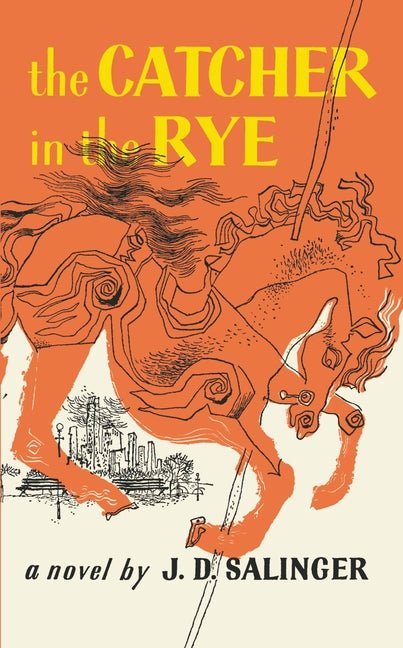
The Catcher in the Rye
by J D Salinger
 )
Couldn't load pickup availability
CELEBRATING 75 YEARS OF THE CATCHER IN THE RYE, 1951 - 2026
The "brilliant, funny, meaningful novel" (The New Yorker) that established J. D. Salinger as a leading voice in American literature--and that has instilled in millions of readers around the world a lifelong love of books.
"If you really want to hear about it, the first thing you'll probably want to know is where I was born, and what my lousy childhood was like, and how my parents were occupied and all before they had me, and all that David Copperfield kind of crap, but I don't feel like going into it, if you want to know the truth."
The hero-narrator of The Catcher in the Rye is an ancient child of sixteen, a native New Yorker named Holden Caulfield. Through circumstances that tend to preclude adult, secondhand description, he leaves his prep school in Pennsylvania and goes underground in New York City for three days, grappling with feelings of loneliness, grief, and alienation. His search for something genuine in a world that feels insincere and superficial remains urgent and unmistakably modern.
In Holden's comic, cutting, and painfully sincere voice, readers discover a comradeship and understanding as they recognize the ache of being lost, and the impulse toward rebellion that comes with the passage into adulthood. The Catcher in the Rye resonates deeply and personally for every new reader.
Share
Book Details
- ISBN
- 9780316769532
- Binding
- Hardcover
- Authors
- J D Salinger
- Publisher
- Little, Brown Paperbacks
- Published Date
- July 16, 1951
- Language
- English
- Pages
- 288
- Physical Info
- 1.11 in H x 8.43 in L x 5.33 in W (0.25 lb)


I am an older woman remembering that a college English professor said that everyone should read this book. I read as much as I could but I do not relate very well to the young college men and dropouts, much less their conversation, which I guess was notable in its time for its honesty, but not for me.
Always a great book -son loved it and it was easy reading for the summer
I got this for my daughter, she was pleased to add this to her collection.
ok
Salinger intended "Catcher in the Rye" only as an adult novel, not the teen cult classic it became. It was an assigned novel when I was in high-school English, and had a lasting and not necessarily positive effect on my personality. Like so many other teen readers, I identified with Holden Caulfield's cynicism and sense of alienation from mainstream society at that time, and it took me quite a while to get over that. Now I'm 75, and I wanted to read it again and see how I react to it as an adult.
- 5 stars: 11 (55%)
- 4 stars: 5 (25%)
- 3 stars: 2 (10%)
- 2 stars: 1 (5%)
- 1 star: 1 (5%)
I am an older woman remembering that a college English professor said that everyone should read this book. I read as much as I could but I do not relate very well to the young college men and dropouts, much less their conversation, which I guess was notable in its time for its honesty, but not for me.
Always a great book -son loved it and it was easy reading for the summer
I got this for my daughter, she was pleased to add this to her collection.
ok
Salinger intended "Catcher in the Rye" only as an adult novel, not the teen cult classic it became. It was an assigned novel when I was in high-school English, and had a lasting and not necessarily positive effect on my personality. Like so many other teen readers, I identified with Holden Caulfield's cynicism and sense of alienation from mainstream society at that time, and it took me quite a while to get over that. Now I'm 75, and I wanted to read it again and see how I react to it as an adult.
Gives a scathing portrayal of upper socioeconomic class in US. Depressingly accurate even if it is narrowly focused. Good insight around how depression can loop your thinking and reinforce itself.
The book came in perfect, no damages and stuff like that.
Story is great but wanted a prettier cover art wirk for my bookshelf
Raw and Real The Catcher in the Rye is a solid read—Holden Caulfield’s a messed-up kid wandering New York, ranting about “phonies” and life’s fakeness. It’s not action-packed, just him thinking and talking, but it feels honest. His obsession with protecting innocence is touching, though his whining can drag. The casual, real vibe pulls you in. Not upbeat, but worth it if you like raw, no-filter stories. 4 stars—good, not perfect
J.D. Salinger's 'The Catcher in the Rye' is a timeless classic that takes readers on a poignant journey into the mind of its young protagonist, Holden Caulfield. The novel presents a raw and introspective narrative, centered around the disillusioned yet perceptive sixteen-year-old navigating the complexities of life in New York City.Salinger's masterful storytelling unfolds as Holden Caulfield embarks on a three-day odyssey after leaving his prep school, delving into the heart of New York City. The novel artfully weaves the voices of children, adults, and the underground society, but it is Holden's voice that resonates the loudest. His eloquence, a blend of simplicity and complexity, offers a deeply personal insight into his world.Holden Caulfield emerges as a character both relatable and enigmatic, his yearning for authenticity and genuine human connection palpable throughout the narrative. Salinger beautifully captures the tumultuous emotions and inner turmoil of adolescence, making the character and his experiences incredibly genuine and evocative.The novel's brilliance lies in Salinger's ability to transcend vernacular while maintaining an authentic portrayal of Holden's unique voice. The contrast between Holden's attraction to beauty and his internal pain creates a compelling duality that resonates with readers. Holden's self-imposed isolation and his struggle to grapple with life's complexities evoke both empathy and admiration for his resilience.'The Catcher in the Rye' is a testament to the human experience, exploring themes of identity, alienation, and the search for meaning. Salinger skillfully delves into the complexities of the human psyche, capturing the bittersweet essence of adolescence and the struggle to preserve innocence in a world filled with hypocrisy and disillusionment.This novel is not just a story; it's an exploration of the human condition, an invitation to reflect on the universal themes of pain, pleasure, and the human quest for authenticity. Holden Caulfield's journey is a mirror reflecting the turbulence and genuine emotions that shape the adolescent experience.While some readers may find the themes and Holden's perspective challenging, 'The Catcher in the Rye' remains an enduring classic that continues to captivate audiences with its richly textured narrative and its unflinching portrayal of youth and society.I rate 'The Catcher in the Rye' with four stars for its timeless relevance, evocative storytelling, and its enduring ability to connect with readers across generations, inviting them to ponder the complexities of the human condition.
2009 Review:Liked it way better the second time around. This is a really compelling character study that can’t help but make you examine your own pride and hypocrisy.B+2020 Commentary:The first time I read The Catcher in the Rye was pretty memorable. Not because it was hugely impactful, but because I read it all in a day in between bouts of crazy projectile vomit. I’m not the type of person to throw up. Or to talk about it, for that matter. Gross. But this was something special. We were driving up to the Tahoe area. My mom, a sister, and me. Oh, and a distant cousin who had just flown in from Argentina, spoke little English, and seemed to be a little overwhelmed by her first visit to America. I’m sure it helped when halfway through the drive I halfway blurted out, “Pull over,” as my stomach contents shot out across the halfway opened door and scattered across the highway as my mom swerved to the shoulder so I could finish my business. In the midst of barfing I remember feeling so sorry for poor Anna Clara. What a welcome.The rest of the drive was uneventful. Unless you count the five other emergency stops we made. For the next day and a half I was lying in bed with a big plastic bowl and a copy of The Catcher in the Rye resting on my chest. I would read a chapter and then hunch over to examine the inside of the bowl while involuntarily convulsing and dry heaving. I’m normally the type of person that pukes once and is done with it. This was the worst stomach flu I’ve ever experienced. But Salinger helped to distract me. I was fascinated by this boy that seemed more grown up than me, but the same level of a silly phony. I enjoyed the cynical internal dialogue as it served as a sort of permission for me to embrace my cynicism while reminding me that maintaining an internal balance is a surer way to peace.My first reading of this book was tarnished by my illness. It’s hard to really love a book when in such discomfort. But it was comforting to have a companion to sit with me in my sickbed. That’s what books have so often been to me. Companions in my internal, solitary world.When I returned to the book several years later (back in 2009) I saw way more of myself in Holden Caulfield. It was more visceral, more personal, more embarrassing to read this book for a second time as a young man still too judgmental, too critical of others, too oblivious of his own shortcomings. It’s a book I should revisit again someday soon to remind myself anew. In fact, maybe I’ll just keep a copy with me at all times--what could go wrong?
We've all heard of this book forever. Mark David Chapman certainly did his part to publicize it as he sat with a copy on the sidewalk of the Dakota apartment building after shooting John Lennon. When asked why he did it, he famously said to read the book and that would explain it. Like Truman Capote's In Cold Blood, I've never been especially interested in why murderers murder, so I didn't take the bait. However, HBO recently did a series on J.D. Salinger and it inspired me to finally read the dang book. One scene shows a college lit class and everyone is salivating on the greatness of the book. It seemed to have all the answers to every question ever posed. People pursued the author to the end of his life like they would a religious cult leader looking for answers to existence! Salinger saw himself as the superior to Hemingway, Thomas Wolfe and pretty much all living novelists of the 20th Century. And I sure didn't want to miss a major writer's major book, so I finally read the thing.Context----after World War II, we seem to have been inundated with the cult of the Angry Young Man. There's Marlon Brando and James Dean movies, there's books by Jack Kerouac on the subject. So if you like these "Rebels Without a Cause," types, you probably will love Salingers's Holden Caulfield. LIke the type, he's enraged by everything in society and he doesn't know why exactly. He believes everything and everyone is a "phony" and that gives him license to go around piqued at the world. At least in the 1960s, we had Rebels WITH a Cause, But in the 50s, the rebels had no idea why they were tilting at all the windmills. I prefer my rebels to know what they're rebelling against, but that's just me. I've known my share of Angry Young Men in my time, and most of the time they can't tell you what they're angry at either. If you're one of them, then you might love this book. Most of the Angry Young Men I personally know either end up dead in car wrecks, drug overdoses, or they get married early and become Angry Old Men who still can't explain why they're angry. I suppose you're interested in the type if you're an Angry Young Man yourself, or you're one of these females who write letters to convinced murderers in prison.[In case you haven't read the thing, here's a brief synopsis if you're interested----Holden Caulfield is a rich 16 year old from New York who keeps getting kicked out of private schools. He's inarticulate, self-absorbed and disdainful of everything. He drinks, goes to nightclubs, roams the streets at night never knowing why.] That's it. You can also summarize Jack Kerouac's On the Road in a similar vein-----a group of Angry Young Men drive and hitchhike across America over and over and over not knowing why. But Kerouac's characters are articulate at least. Holden Caulfield is an uninteresting moron. Thank God Salinger didn't write a sequel.So all right----I'll give Salinger credit for being the first to identify the type of the Angry Young Man. That alone makes the book important for post-war society. Capote made murderers interesting. Kerouac made rambling men interesting. But that's about it. This book is narrated by Caulfield, who is self unaware and dim-witted. After I realized late in the book that nothing exciting (like an assassination) was going to result, I couldn't wait to finish the thing and put it on the shelf and then I'd be able to say, "Of course I've read it----hasn't everybody?" So now I can do that. I'm not saying don't read it. But I will say it needs to be at the bottom of the list of books you should read. If you like your novels, do Hemingway, Philip Roth, Kurt Vonnegut or Thomas Wolfe or TOM Wolfe! I'm just glad Salinger stopped after this one. He strikes me as a songwriter who wrote a song in 1957 about a kid who fell in love at first sight with his school librarian because of her color of lipstick. And then he replaced her with his English teacher because of the color of her shoes and wrote a SONG about it that made it to #17 on the Top 40. And he never writes another song but goes through the rest of life believing he's now Bob Dylan and John Lennon rolled into one. Somebody should have told him he was wrong.
I honestly believe this was one of the best American books ever written and I feel like I walked in Holden's shoes for many years like many probably do. We all strive to be Holden Caufield at some point in our lives or throughout our lives but rarely can due to social restrictions of being adults. Basically as my roommate puts it, Caufield is the guy that says what everyone else is thinking but just can't. He is a paradox in everything we think is human---whether his physical resemblance compared to his age (over 6 feet with gray hair), his sexual feelings to many of the women he meets---he falls in love with the little things he sees special within a person (you think his age would be on looks), his adventures and social interactions with the world (he's a teenager in high school hiring hookers and living in a hotel by himself, while going out and buying drinks). Yet, he is the protector of innocence (love his sister Phoebe), distinguishes bs from reality (calls out the people near him for what they really are). He's no doubt a cynic, and others will go as far to say, he's just whiny at times without fully understanding everything. But to me, his positives definitely outweigh any of his negatives as an individual. Yeah he's not the best student which is why we know he's leaving his prep school (schooling and grades are a social construct based to judge people based on merit and ability), but what is education in the end of the day? To me, it is the ability to learn from mentors (he has a few which he respects but thinks critically of them)-check, learn how we can make it in this world (his trip is a stage towards total independence without holding hands) -check, and making sure, his character is intact no matter what situation he is in and not to back away from principle (could have just paid $5 more to the hooker, but why is he sacrificing himself for principle---because integrity shouldn't be lost on an individual no matter what the magnitude of the situation is. I can't help, but think of Dr.MLK's famous quote, "The function of education is to teach one to think intensively and to think critically. Intelligence plus character - that is the goal of true education." He got all these great characteristics and Salinger puts in a great deal of meaning through the structure of his wording & plot devices like his red hunting cap. A great analysis of the story is done on youtube by another great author named John Green if you want some deep& meaningful commentary after you finish the book. But honestly, I am very thankful I read this book at the age of 28 in its entirety and not only read 40 pages like I did in high school, sparknoting the rest, to me, it personally gives my life a lot more meaning because Holden Caufield is someone I strived to be without really ever knowing it. The background of JD Salinger's war experience and him writing this story after his service in WWII also puts the story in greater perspective, if your a history buff like me. I'll read this story a few more times in my lifetime and hope I can extract newer meaning from after each reading with prolonged years in between.
I don’t like Holden Caulfield. In fact, I can’t stand him. He’s everything he despises in other people: phony, a compulsive liar, hypocritical, selfish and self-centered. He’s also pessimistic, cynical, very judgmental, critical, and hopelessly depressing. Is it any wonder why he is always so depressed? He cannot stand his own company. But there are moments I felt some kind of compassion for him. Or is it just pity? It’s pity. Like when we learn that his younger brother Allie died from leukemia. Or the suicide of a boy he knew in school. His brother’s death, more than anything, is what may have propelled him to self-destruction. Being so young (a teenager), it is understandable that he has not learned to cope with his brother’s death. He’s also a self-proclaimed atheist and comes from a family that are atheists or at least agnostic. They really do not believe in anything. This, coupled with the tragic loss of his brother has left him unable to deal with loss. There is nothing for him to grasp onto. He is empty inside, and that emptiness is filled with cynicism that borders on despair. It’s no wonder he has flunked out of so many schools. What’s the point of living? That’s what he is probably thinking. Kids his age are phony. Adults are phony. Life is phony. This colors his outlook, or rather, drains all color from life itself. He is shuffled around from one school to another, one day to another, one moment to another. The only thing that brings him any joy is his sister Phoebe, just as Allie once did. He obviously loves her. He is capable of some degree of love, but so torn up inside that he cannot deal with anything. Then there is his curiosity about the ducks at the lagoon in Central Park. Where do they go in the winter when the water freezes? He is like those ducks, and his is stuck in a long winter that might have begun with this brother’s death. There is no place for him to go. Though I suspect he was already a cynical person before Allie’s death. Sarcastic at least. The death just made him more so. It would be interesting to see Holden 10 years later. Or 20 even. Would he have changed at all? I doubt it. People don’t usually change. If they have a streak of sarcasm, it often only becomes more pronounced with age. I can imagine Holden as a grumpy old man. If he made it that far. I don’t know. He seemed bent on self-destruction. He might have died in his 20s or 30s. Maybe even have taken his own life. But despite all his cynicism, he seems to also have a survivor’s streak. Maybe he would have eventually emerged from this pit of darkness. Maybe. I certainly hope so. For his sake.So why did I give 5 stars to a book with a protagonist I cannot stand? Because J.D. Salinger did a remarkable job of creating him. The fact that people react strongly to this character speaks of the author’s skill in creating him. Holden’s cynical attitude, his foul language, his shifty distrusting eyes, his body language…. It’s all very real and thoroughly depicted. And this resonates with the reader. It definitely leaves an impression. Even if some people like me don’t like Holden, Salinger pulled it off. It deserves 5 stars.
I thought it was the biggest waste of time.Following the recent death of JD Salinger, I realized I had never read this classic. I had often heard it referred to, especially in circles of child behavioral disability and learning disabilities, so having raised one of those boys, I thought I would take a peek.I think the argument in favor was that it was different for it's time. A "coming of age" story, and was resonated with due to the theme of teenage angst. Published in 1945, I can only imagine the uproar it caused due to the rawness of the material (tame by today's standards, so actually boring). If I consider the climate of 1945 and how teens were supposed to be behaving and perceived, this would have been one of those books that caused such a stink that people would buy it and read it just to see what the stink was about. Controversy sells. Sort of like The Last Temptation of Christ. Nothing makes me want to read or see something quite like people saying "don't do it...it is horrible".I'm going to step into the character of Holden and tell you how he would tell you about this book:"I can't believe all the goddamn phonies who say this is such a hot book and all, I really can't. I mean, what I mean is, it's just a book of random thoughts for chrissake. The entire book takes place in like 3 or 4 days of my lousy life after finding out I had been kicked out of yet one more fancy-pants school my parents wanted me to go to, and what I did during those days, and the junk I thought about. Seemed more like a million years that four or so days. It would depress the hell out of you if you read it, it really would, if you wanna know the truth. I don't see the goddamn point. Literary people are just a bunch of phonies who think something is good and tell people its good when it really isn't. They kill me, they really do."That's it to me! Those types of phrases are throughout the entire book. I've got no problem with swearing, but it was about every other sentence, so got monotonous. I could care less about the moral objections to the book. By today's standards, it's no big deal. A kid who gets access to alcohol, goes to bars, swears, drops out of school and contemplates hooking up with chicks. No big deal.Mostly, I was BORED. The book was not a compelling read. And I kept waiting for it to GO somewhere.From a mental health professional standpoint, I think all the buzz about Holden representing a kid with mental illness and or learning disabilities is a bit of a stretch. It could be ANY kid. He could go through those phases in his rebellion of finding himself as separate from his affluent background. On the other hand, I could clearly see the signs of extreme anxiety, mood swings, obsessive compulsive thought/behavior, and repeated school failure despite demonstrating high intelligence...so it could or it couldn't be indicative...worthy of seeing a counselor for sure. Seems like he was invisible to his parents unless he was in trouble.He was a sensitive guy who clearly loved his siblings, but had zero tolerance for what he perceived as "phonies" and an inordinately adept skill for seeing hipocracy everywhere. He had no ability to see the gray...all was black and white, good or bad, love or hate and he couldn't make up his mind which way he swung on any moment. He appeared to long to be understood, heard and assisted but all anyone could do was show him his failures, not assist him with a path he could be successful with. And there was HUMOR. I laughed a few times. There was raw honesty and I could see some of my feelings as a teen portrayed in him.So I guess I understand the potential value, but thought it was the most boring book on the planet...I really did...a godddam bore for chrissake...with a bunch of "emperor's new clothes" critics pushing it to stardom. I think also, the fact that J.D. Salinger stayed in seclusion and did not seek or want or welcome fame, made him a mysterious figure that people became interested in and his very avoidance of fame pushed him unwillingly toward it.I don't think it should be banned from schools, and I have no real problem with teens reading it (I don't think it seems a good idea for grade or Jr high schools), but I'm not sure where the real value of reading it is...is it assumed because of the questionable subject matter kids will want to read it and it is a way to get "the medicine to go down"? I guess with the right group, the very discussion of "why in the world did this get to be a classic?" is a good discussion place. So I have no moral objection, I just fail to see the value in it.It is a "classic" so I know there must be a lot of fans of it out there. Tell me why you loved or hated it, or if you fall somewhere in between. I'm glad I can say I read it, so I can be one of those phonies who at least knows what it's about rather than always wondering. Yet I also feel like it is a few hours of my life lost that I'll never get back and could have spent on something better.
I'm not really quite sure what all the fuss is about this book...I certainly found the narrative engaging, and I really enjoyed the authenticity with which Holden seemed to speak and express himself, but, while I identified with much of the way he felt and (re)acted, and the internal monologues were simply dead-on perfect, I never really connected with anything until I was nearly 90% finished. Perhaps had I read this when I was younger it would have affected me more, but now, as I try to find or create a connection, I'm just left... Well. I'm just left.It was Mr. Antolini's note to Holden that finally grabbed my attention."It is the mark of an immature man that he wants to die nobly for a cause, while it is the mark of a mature man that he wants to live humbly for one."I was told I was too immature recently, and it just killed me. "Boy, it really did."I tried to figure it out and tried to understand how I gave that off. Without truly knowing what I was doing, I think I realized that I had given up on the option of living humbly (or living at all) for any cause at all long ago. Whether it be something, someone, or just myself. At some point I was finally able to see something in front of me and felt like I understood what it was to live for something. Not just, as I've often thought in the past, to be the catcher in the rye for anyone who strayed too close to the edge but to be the catcher for a specific reason... and to equally allow the possibility that I also, at times, might need a catcher myself. I wish I had the gift of speech and introspection such that I could have so succinctly put my thoughts, feelings, and actions into words.This epiphany... or at least the motivation for it... evaporated quite quickly, and I, missing the point, fell back into searching for something for which I could nobly die.To see Holden cry for and over his little sister for whom he obviously held a great respect and had the utmost love, come to the conclusion that he should not tell anyone anything was quite rather depressing. I waver, but is it worse to live in fear of missing someone and, therefore, remain isolated or is it worse to allow yourself to catch and be caught and, inevitably, miss those who caught you and are now gone? Did he "really like" people who were dead precisely because the only thing left to do was miss them? Knowing there was no hope of actually being open with those that he'd lost and, therefore, no risk in missing them more seems like the perfect depressing escape. One with which, in the past, I likely would have agreed completely. I still struggle with that question today, and I honestly don't know the answer, but I am glad this book turned out the way it did giving me another pretty clear perspective into one potential answer to one of life's most important questions.For Holden to have kept Mr. Antolini's paper (especially in a way that seemed meaningful to him) and still arrive at his final conclusion was a bit jarring. Especially in light of the final scenes when he *should* have been able to see the cause right in front of his face, even if he couldn't realize that he himself was cause enough.Sooo... I had to try pretty hard to pull something out of this that seemed to really matter to me, but I think I got it. Or at least I got something. Overall, enjoyable, but nothing particularly amazing. At least I can now say that I've read it.
One scene that has always stuck in my mind in "It's A Wonderful Life" is when George Bailey and his future wife were talking and George was taking his time on making his move to kiss her for the first time, when in the background an old man said "Well are you going to kiss her or not, ahh youth is wasted on the young." To my way of thinking many classic novels which we as in our youth had to read and study and be tested on in high school and later in college, were actually never really fully understood or appreciated. To me, I was told to read these books and later the teacher or the professor would lecture and have active discussions in detail of the nuances and literal and figurative interpretations on the intentions of the author and the real plot of what the author was trying to convey to the reader. The better students would learn the triggers of success and mimic their instructor's persuasions and add "a little" of how the novel affected them in their young lives. But my take on many of these classics actually confused me and being the rebellious student that I was I usually didn't go with the program and in many instances took my rebellion in the force of protest and usually ended up with an old-fashioned hook a C. I did the same thing when I first read "Catcher in the Rye" in fact being very much like Holden Caulfield in my studies of this novel. The fact remains that as one grows older one gains from life experiences and is able to appreciate life on a wider and more knowledgeable scale. I have spent most of my academic life reading and writing of history and life memoirs of things that have actually happened. My studies were based on things that have happened. However I find myself being brought back to the classics and with that added maturity, I have found out that I do indeed understand them better. J. D. Salinger was really writing of his youth when he wrote this book. Holden Caulfield is a dysfunctional youth who in all reality hates the concept of growing up and following teacher or parental guidance or instruction. Being born to wealth and surrounded by siblings who all seemed to be normally adjusted youths, Holden held out to be the family "black sheep." The traumatic effect of his younger brother's death had deeply disturbed Holden. In fact this event may have started the trigger that he would rather remain a child and not grow up in the "phony" lifestyle of being an adult. The other key sibling that Holden held in very high regard was Phoebe who he regarded as not only as a sister but a person who personified the goodness in the essence of what youth is. Simple and loving! The book is written in the first person by Holden Caulfield and it tells of his relationships with his classmates, teachers and his parents. It is written in the mind of a seventeen year old which is contradictory, whimsical, funny, mad, nonsensical and at times very funny. In fact it does represent the brain of a person who has not fully developed. To tell you the truth this writing in the vernacular of a teenager, represents the brilliance of Salinger's writing. Some youth can adapt to the adult world and move on; others like Holden have a very hard time in doing so. My review intent is not to give away the meaning and plot of this classic book but to rather engage the reader to see that this book is indeed of deep meaning in which I never recognized 46 years ago. The meaning of the title makes sense as it never did before and as an added insertion to my discoveries I found this book to coincide greatly with the story of "Peter Pan." If you have never read the book do so. If you read it as a young student, I daresay read it again, it will surprise you!!!!

