

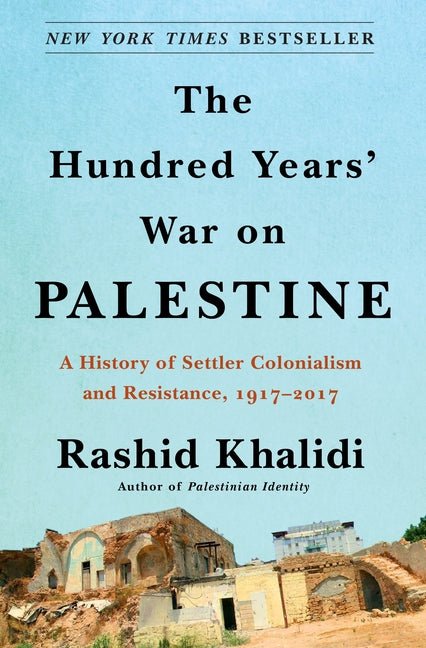
The Hundred Years' War on Palestine: A History of Settler Colonialism and Resistance, 1917-2017
Couldn't load pickup availability
A landmark history of one hundred years of war waged against the Palestinians from the foremost US historian of the Middle East, told through pivotal events and family history
In 1899, Yusuf Diya al-Khalidi, mayor of Jerusalem, alarmed by the Zionist call to create a Jewish national home in Palestine, wrote a letter aimed at Theodore Herzl: the country had an indigenous people who would not easily accept their own displacement. He warned of the perils ahead, ending his note, "in the name of God, let Palestine be left alone." Thus Rashid Khalidi, al-Khalidi's great-great-nephew, begins this sweeping history, the first general account of the conflict told from an explicitly Palestinian perspective.
Drawing on a wealth of untapped archival materials and the reports of generations of family members--mayors, judges, scholars, diplomats, and journalists--The Hundred Years' War on Palestine upends accepted interpretations of the conflict, which tend, at best, to describe a tragic clash between two peoples with claims to the same territory. Instead, Khalidi traces a hundred years of colonial war on the Palestinians, waged first by the Zionist movement and then Israel, but backed by Britain and the United States, the great powers of the age. He highlights the key episodes in this colonial campaign, from the 1917 Balfour Declaration to the destruction of Palestine in 1948, from Israel's 1982 invasion of Lebanon to the endless and futile peace process.
Original, authoritative, and important, The Hundred Years' War on Palestine is not a chronicle of victimization, nor does it whitewash the mistakes of Palestinian leaders or deny the emergence of national movements on both sides. In reevaluating the forces arrayed against the Palestinians, it offers an illuminating new view of a conflict that continues to this day.
Share
Book Details
- ISBN
- 9781627798556
- Binding
- Hardcover
- Authors
- Rashid Khalidi
- Publisher
- Metropolitan Books
- Published Date
- January 28, 2020
- Language
- English
- Pages
- 336
- Physical Info
- 1.2 in H x 9.6 in L x 6.3 in W (1.15 lb)
This book completely changed the way I see the history of Palestine and Israel. Rashid Khalidi writes with clarity and compassion — it feels both scholarly and personal. He connects historical facts, family memories, and political analysis in a way that makes the story come alive. It’s not a light read, but every chapter leaves you thinking. If you’re looking for something serious, honest, and deeply researched, this is one of the best books on the topic I’ve read. Highly recommend for readers who want to understand context, not just headlines.
As a Vietnamese American, we were given a narrative that Israel is good and that the Middle East hated them for no reason. Once I started seeing images of deceased children in Gaza, I wanted to read the viewpoint of Palestinians and understand the history. This book made me realize how brainwashed I was. I never once thought to think about the perspective of Palestinians. This made me read other books about the history. I read both sides. The more I read and understood the history and the context, the more I grew to hate Israel and the western powers that lied to the world about this issue. The west stole Arab land and told us that Arabs are terrorists. Israel is and has always been the terrorist of the region. It was all lies and propaganda. Free Palestine.
The book you should be reading.
Everyone needs to read this to arm themselves with the truth during a surreal time of American-led genocide against the Palestinians. The British invaded Palestine in 1917 and manipulated the people in so many ways imaginable. Newspapers were banned and mention of the Balfour Declaration was prohibited.Long after this genocide, people will try to whitewash the truth. You owe it to humanity to know the truth and to defend people who strive to be free.
This book changed my life. I was woefully ill-informed about the modern history of Palestine (and that is pretty inexcusable for a clergyperson), and this book gave me the facts I needed to clarify and stand by my moral commitments. The argument that "if you are pro-Palestinian then you are anti-Semitic" doesn't hold water, full stop. Also ... I have rarely read a more satisfying conclusion chapter, where the author brings in fresh insight and connects the dots, keeping us learning and expanding to the very end. Bravo, and thank you, Rashid Khalidi.

