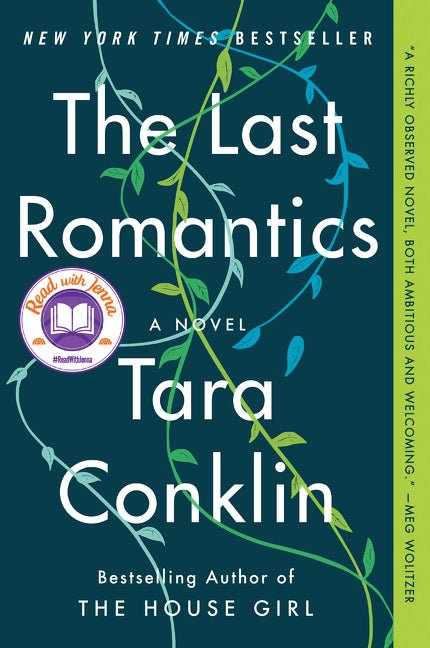
The Last Romantics: A Read with Jenna Pick
by Tara Conklin
)
Shop All Audiobooks
*When you open this audiobook on Libro.fm, be sure to select Aveson as your bookstore so that your purchase supports local literacy programs and tree‑planting.
Couldn't load pickup availability
A Read with Jenna Today Show Book Club Pick!
An Instant New York Times Bestseller
Named a Best Book of the Month by Goodreads - Lithub - Refinery29 - InStyle - HelloGiggles - Real Simple - Parade - PureWow - Bustle
"A richly observed novel, both ambitious and welcoming." -- Meg Wolitzer
A sweeping yet intimate epic about one American family, The Last Romantics is an unforgettable exploration of the ties that bind us together, the responsibilities we embrace and the duties we resent, and how we can lose--and sometimes rescue--the ones we love.
When the renowned poet Fiona Skinner is asked about the inspiration behind her iconic work, The Love Poem, she tells her audience a story about her family and a betrayal that reverberates through time.
It begins in a big yellow house with a funeral, an iron poker, and a brief variation forever known as the Pause: a free and feral summer in a middle-class Connecticut town. Caught between the predictable life they once led and an uncertain future that stretches before them, the Skinner siblings--fierce Renee, sensitive Caroline, golden boy Joe and watchful Fiona--emerge from the Pause staunchly loyal and deeply connected. Two decades later, the siblings find themselves once again confronted with a family crisis that tests the strength of these bonds and forces them to question the life choices they've made and ask what, exactly, they will do for love.
A novel that pierces the heart and lingers in the mind, The Last Romantics is a beautiful meditation on the power of stories--how they navigate us through difficult times, help us understand the past, and point the way toward our future.
Share
Book Details
ISBN:
9780062358219
EAN:
9780062358219
Binding:
Paperback
Pages:
384
Authors:
Tara Conklin
Publisher:
Mariner Books

This book was well written and had some really decent descriptions of some experiences. I’m not sure if it was intentional, but none of the characters are really like able. It also had a lot of cheap woke references that so many modern books have that didn’t really add to the story. However, if you’ve ever been through some of the main themes in the book, it’s pretty decent.
The Last Romantics is the story of what happens when four siblings are left to raise themselves for a few years in early adolescence when their father dies suddenly and their mother slides into deep depression. The "Pause" dramatically affects each sibling differently, even shatters them on one level or another, especially when it comes to the deepest emotion us humans know - love. These broken souls protect themselves by leading extremely different lives, which are often confusing, frustrating, and sad. The story is told by the longest survivor of the Skinner family when she is 102. Climate change is addressed, but not consistently throughout the book, but hey, the good news is, the world didn't end in 2050, as this book starts in 2079 and quickly turns back to the beginning of this family's troubles. The reader cannot escape the bleakness of life in this novel. When, at the end, the author sums up what the book was truly about, I was not as moved as the close to 600 readers who chose to highlight it. My thought was that it was about avoiding love, and scoffing at anything traditional. But then, I'm old.
Our neighbors passed this book to me during the shutdown and I read it and passed it to other neighbors. We all agreed - the best book we have read in years. I've since bought more copies and sent them to friends and family members. When discussing the book, we haven't been able to pinpoint its charm - the characters are great and well developed. You can see the scenes in your mind's eye as you read, it's that good. Some of my family members and friends are keeping the book to reread. I will reread it too!
If you've read Conklin's The House Girl, this is totally different.The Last Romantics is a saga of the Skinner family, four siblings who lose their father at an early age. They also lose their mother for a time period as she copes with her husband's death. The beauty of this book, besides the flashbacks from the future as Fiona, the youngest Skinner, tells the family's tale, is the way Conklin creates the story for each sibling. Even though Fiona relates the family drama, each sibling also tells his/her own tale.As I became aware that Fiona was winding down her tale, I became nostalgic and rueful. I wanted more both of Conklin's writing and the Skinner saga.This book has been compared to The Immortalists and I would agree with the whole sibling dynamic piece, but The Last Romantics made me connect more with the family. I really did want their tale (and lives) to go on and on.
This book is surprising in many ways, and I am glad that I read it. The writing is very skillful. Our author has an excellent command of language and complex literary structure. What is even more unusual is that she uses both in a way that is unobtrusive and effective. In other words, even though how she says things is remarkable, the “how” is never more important than the substance of what she says. We have all read books that were just so pretentious or “precious” in their structure and word selection and the essence is lost. That does not happen here. The story focusses on the lives of three sisters and a brother. The youngest sister, Fiona, is the narrator. Her father’s sudden death sends her mother into a tailspin and the children spend several years raising themselves until their mother emerges from her bedroom and her breakdown. There are flashforwards to Fiona in 2079 as an elderly woman and successful poet. A question from an audience member at a lecture casts her back through her memories to her life as a child and young adult. These are not people that I know, but the characters rang true, and I cared about them. It is a thoughtful book that leads to contemplation rather than tears. I almost never highlight a passage in a book, but I found myself pausing to reflect on passages. Ultimately, I highlighted about five sections that I wanted to be able to find easily and read again. The book is rich in details and words. There are elements, particularly about the future setting, that may seem irrelevant to the main plot, but these details add a great deal to the veracity and the richness. I thought they were tremendously interesting, so I say thank you to the editor who allowed them to stay. At its heart, this is a story about love. About the failures of love, the negotiations of love, the struggles of love, the joys of love, the comforts of love, the hope of love. This is an exceptionally fine novel that I will remember.
)