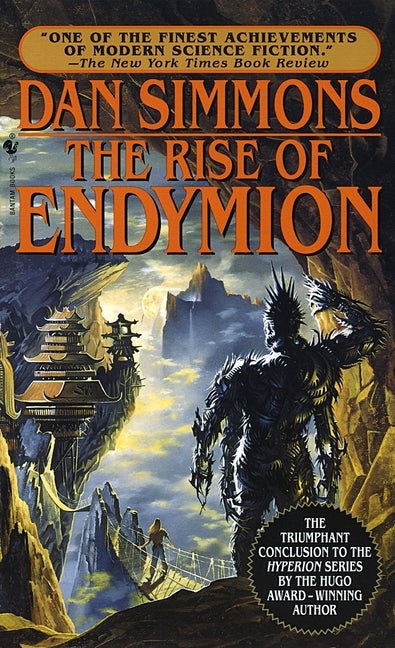
Well I had high hopes for The Rise of Endymion. I loved Hyperion and enjoyed its sequels The Fall of Hyperion and Endymion. Endymion began a fresh new storyline set a couple hundred years after the events in Fall. The child Aenea emerged from one of the Time Tombs with prophetic knowledge of future events and a tentative understanding of the Void Which Binds and the true nature of the Technocore. Simmons did a nice job characterizing Aenea: still immature but much more than meets the eye. The contrast between her personality and that of the skilled adult protector Raul Endymion helped make the novel a fun read. The novel ended with Raul and Aenea eventually escaping from the Pax and Core. Rise continues and concludes the story begun in Endymion.I dove into Rise with the expectation of a climactic resolution of the struggle between humanity and the Technocore. It started off well. The first half of the novel alternates between the viewpoints of Raul Endymion and the bad guys. The "chase" that developed the tension in Endymion continues here and gets quite exciting as Core entities eventually catch up to Raul and Aenea. We visit several unusual and interesting worlds. I was thrilled when the Consul's ship appeared unexpectedly at a dramatic point in the story. I rate this part of the novel a solid four stars.But the second half, ugh. This is Aenea's knowledge disemmination phase, where she gets on her soapbox and speaks in completely unnecessary riddles that she promises to explain later. She doesn't keep all her promises and the explanations she does give are largely unsatisfying and some of them contradict what we learned in the first two books. For example, the Technocore is revealed to be entirely different from how Ummon described it in Fall. Even worse, we are only exposed to the evil factions in the Core and never meet the good ones. Wait until you learn where the physical location of the Technocore is. What a letdown! Also, we never meet the mysterious powerful alien beings labeled as "lions, tigers, and bears". We only get to learn who one of their agents is, and that doesn't help much because he doesn't reveal *anything* about his species and its powerful allies.A couple more negatives: The ending is poor, unimaginative, and unsurprising. The many love scenes are corny and were obviously filler material to add an element of sex to the novel, because they don't fit in well with the plot at all. Characterization of Raul and Aenea was nice in Endymion but took a nosedive in Rise. In fact, I often found myself wanting to skip the adventures of Raul and Aenea so I could go back to reading about the evil characters! This time around Raul barely seems to have a mind of his own; he just goes around and reacts to events the best he can, completely unlike in the prequel where he took charge most of the time. Aenea is now a boring teacher spouting nonsense about Love being the source of virtually limitless energy in the Void Which Binds and other esoteric drivel. Both main characters were extremely shallow in this novel. The only interesting ones are Father de Soya, some of the evil guys like Lourdusamy, and a couple others. Albedo of the Core was interesting until his final scene where he became the stereotypical supremely evil being screaming in rage at defeat.It seems like Simmons is done with this series because he made such a valiant effort to resolve the many loose ends that the previous three books left. Truth be told, the book would likely have been better if Simmons had simply deleted most of Aenea's silly explanations and philosophy (recovering about 200 pages) and left us with the adequate framework we had from the previous three books. Also he should have brought the "good" Technocore factions and alien species into the plot. The end result would have been a book of about the same length but tremendously enriched and on par with the previous novels. I concur with several other disappointed reviewers that you should stop after reading Hyperion and Fall. The problem with reading the otherwise enjoyable Endymion is that you need to read Rise to finish the story. There are lots of positive comments about Rise on Amazon.com and I can agree with many of them, but the novel ultimately falls well below the standard set by the prequels! Overall three stars: well-written initially but too drawn out and capped off with a disappointing ending.


 )
)