

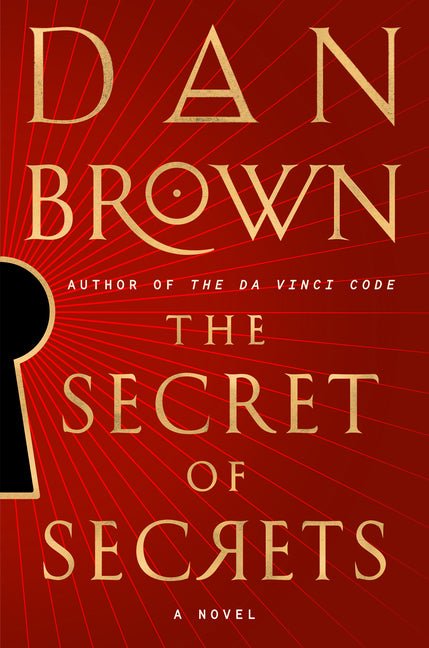
The Secret of Secrets
 )
 )
Couldn't load pickup availability
GLOBAL PHENOMENON NOW AVAILABLE IN PAPERBACK
INSTANT #1 NEW YORK TIMES BESTSELLER
THE NEW ROBERT LANGDON THRILLER FROM THE ICONIC AUTHOR OF THE DA VINCI CODE
The world's most celebrated thriller writer and author of The Da Vinci Code returns with his most stunning novel yet--a propulsive, twisty, thought-provoking masterpiece that will entertain readers as only Dan Brown can do.
Robert Langdon, esteemed professor of symbology, has traveled to Prague to attend a groundbreaking lecture by Katherine Solomon--a prominent noetic scientist with whom he has recently begun a romantic relationship. Katherine is on the verge of publishing a breakthrough book that contains explosive scientific discoveries about the nature of human consciousness . . . revelations that threaten to disrupt centuries of established belief.
When a brutal murder catapults the trip into chaos, Katherine suddenly goes missing--and her manuscript disappears. Desperate to find the woman he loves, Langdon embarks on a thrilling race through the mystical landscape of Prague, ruthlessly hunted by a powerful organization and a chilling assailant sprung from the city's ancient mythology.
As the action expands to London and New York, Langdon plunges into the dual worlds of futuristic science and historical lore--navigating a labyrinth of codes and symbols . . . and finally uncovering a shocking truth about a secret project that will forever change the way we think about the human mind.
Book Details
- ISBN
- 9780385546898
- Binding
- Hardcover
- Authors
- Dan Brown
- Publisher
- Vintage
- Published Date
- September 9, 2025
- Language
- English
- Pages
- 688
- Physical Info
- 1.8 in H x 9 in L x 6.5 in W (2.1 lb)
Dan Brown writing style draws you right into the story. I am not, have not ever been a big book reader; except history. I have read all of Dan Browns books, in like 2 days per book. Once I start, I can't seem to put the book down. I am not a "learned scholar", just "average schmo"... but...GOOD writer/author this Dan Brown guy.

I was so excited to receive my book today, but unfortunately this is the condition that it arrived.

You might not think it possible, but Dan Brown was initially a failed musician and a failed writer. Hardly anyone wanted to buy his records and his books sat on the shelves like lead. But perseverance, hard work and creativity paid off and the result was called "The Da Vinci Code". Since then, Brown has been one of the most successful writers of our time and we can assume that "The Secret of Secrets" will also become another bestseller.Once again, the story centres on Harvard professor Robert Langdon and this time Brown has moved the action to Prague. Langdon is actually only accompanying a friend and she is giving a sensational lecture - the next morning, however, the romantic scientific excursion to the beautiful city turns into a nerve-wracking thriller. As is often the case with Brown, everything happens in the space of a single day. And because he follows clues, he once again gets to the bottom of an extensive conspiracy. Along the way, of course, you learn a lot about the Golden City and its history.Some things are a bit over the top for me. I can't really go into details without giving anything away. But here and there it could have been a little smaller. Nevertheless, it is a very exciting book and I enjoyed reading it from the first to the last page. It is also excellently written, even if the scientific background is sometimes not immediately understandable on first reading - and in my view not always scientifically tenable. But it is also an interesting thought experiment and definitely worth looking into.But again, it is a great book and I am quite sure it will be one of the most successful books of the year.(Sorry for my English, not a native speaker, German.)

Thought provoking book.I am always waiting for Dan Brown books- he manages to present a lot of controversial topics in an extremely entertaining way. I can only imagine how many hours he spends on research to be able to even mention the theories.Dan Brown is obviously an erudite, but I am not and it usually takes me sometime before I can even try to process all the ideas covered. I first read the book just to get to the end of interesting plot of his books. Should mention I read rather fast. But then I return to the book later to go at a slower rate and try to absorb the information and ideas. Brilliant books!
This is a stunner, perhaps the best DB book since The Da Vinci Code.My philosophy of reviewing is that it involves three questions. What did the author set out to do? Did the author accomplish that? Was it worth doing? In the case of DB we have a specific kind of book. It has a pile-driver plot. It has interesting characters but it is not really character-driven. It is popular fiction. In addition to plot its long suits are setting and subject matter. Here we are largely in Prague, with momentary side trips to New York City.The title refers to consciousness (Langdon’s girlfriend Katherine has written a book on the subject). Consciousness is indeed the most challenging element of brain science and it includes both scientific and spiritual dimensions of immense importance. In the novel the plot is advanced by the principal fact that Katherine Solomon’s book on the subject keeps disappearing; someone does not want this book to hit the booksellers’ shelves. Who? Why?DB writes this story with a hand tied behind his back. He requires that the science all be right (this may make it somewhat fanciful, but not science fiction) and that the setting (also something strange and almost mystical) be rendered faithfully and honestly.Bottom line: this is the kind of writing which requires enormous planning and research. At the same time it must be intelligible to a broad range of readers and it must be plausible.The book succeeds on all counts. It is both the ultimate popular read and something with fascinating and important scientific/spiritual content.It is, unmistakably, a ‘Dan Brown book’. It is not Dostoevsky; nor was it meant to be. Those who write condescending reviews of it should themselves attempt to write such a book and they should be reminded that readers can enjoy and admire a wide range of genres and styles. (Yes, I wrote this review after reading a snooty review by an individual who probably longs for an audience as wide as DB’s. And, yes, there is also some puritanism at work there. Great 18thc readers like Addison and Samuel Johnson knew that ‘honest pleasure’—the kind that will neither send you to prison nor to hell—was a great desideratum in our culture, a lesson that is often lost on those who consider such pleasure beneath them.)
I’m already a big fan of Dan Brown, and this book didn’t disappoint. From the very first chapter, it pulled me in and kept me on the edge of my seat. I found myself Googling little bits of information as I went, and to my delight, everything I checked turned out to be true—so I even learned a few new things along the way. The mix of fast-paced suspense and fascinating historical detail is exactly what I love about Brown’s writing. An exciting, thought-provoking read that I couldn’t put down!
It's good but...Starts falling apart near the end when the scientists are discovering the true depths of villainy of their opponents and need to leave the secure facility with the evidence. What do they do? Have a detailed discussion. More talking, discussing, "Wow, look how far they've come!" "Gee maybe we should get out of here?" "But wait! What about this? What about that?" "Oh well, maybe we should talk some more?"Baffling and definitely not aligned with smart thinking, human nature. It's weird. I get the author had to introduce these concepts but it makes the story jarring at this point.
Great plot about a subject very dear to my heart as a licensed acupuncturist & herbalist who practiced Taoist acupuncture & herbal medicine in NYC for years.I also have a great fondness for the fascinating and creative location: the beautiful and unique City of Prague. I’d spent quite a bit of time there when touring with an opera company throughout the Czech Republic. I love both that city and the people of that country!I hope you enjoy this book as much as I did.
Amazon shipped the book without any shrink wrap or bubble wrap, in an oversized box so it arrived banged up and kinda dirty. But the book itself was amazing!I've been a Dan Brown fan for ages and this is, no doubts about it, my favorite book. The topics, the settings, the plot-twists! I loved seeing Robert Langdon again and how even if the book story revolves around science, his Religious Symbology knowledge was masterfully integrated in the plot without it focusing in religion like some of his other books.
I was fascinated by the premise of this book. The idea that conciousness comes from outside the brain and not originating from the brain was new to me. Relating that premise to so many things with which we are all familiar was eye opening. I sometimes had to remind myself that this is a work of fiction. Then to weave a thriller around that premise made for a very good story. Robert Langdon is a tried and true protagonist. Katherine Solomon, a new character, provided a love interest which was missing from earlier Langdon novels and is his intellectual equal. Together they get in and out of any number of life threatening situations in unique and clever ways.The book is too long by 100 pages. The story got overly complex with too many sub-plots. The descriptive passages of Prague as well as the buildings where the story took place and the technical jargon could have been shortened. The supporting cast was not very memorable. All this cost a star in the rating, however, I would still recommend the book to those who love the Robert Langdon series and who enjoy having their core beliefs about how the brain works challenged.
This is the book that returns Dan Brown’s glory to the likes of his early works such as Angels and Demons and Da Vinci Code. His books after DaVinci code, pleasant reads as they are, never gave the same kind of stirring.Until this book comes out!It seems to be the most ambitious topic and most technical concept Mr Brown is trying to bring to us yet with the most approachable language. It’s also got the first class scientific expositions, the typical Dan Brown-ish plot twist, and thefast pace that keeps you on edge which can only be pulled off by Dan Brown.
I just finished Dan Brown’s latest book and wow—it’s a total page-turner. From the very first chapter, you’re thrown into this wild ride full of mystery, secret societies, and unexpected twists. The story moves fast, and just when you think you’ve figured something out, there’s another surprise waiting.The main character gets pulled into a conspiracy that feels bigger than life, and the way everything unfolds keeps you hooked. I couldn’t put it down. The ending? Totally caught me off guard—in a good way.If you like thrillers with puzzles, action, and a bit of historical flavor, this one’s definitely worth reading.
It took three days to devour this book. The narrative was compelling and paced well. The musings on the human mind and consciousness were thought provoking and informative. I loved the references to Prague and the Golem storyThat said, the book needed more editing. The subplots involving the Czech policemen and the various embassy staffers could have been excised from the novel without losing much. Also the lengthy discussions of the science surrounding the mind, while interesting, seemed to drag on forever.I will read his next book, but hope it comes in at less than 500 pages
Dan Brown didn't disappoint and gave us another page turner. The master template, since Angels and Demons up to and including Origin, works here, too, and doesn't feel overused despite the sixth iteration.Conspiracies, puzzles, dead ends, flawed institutions and individuals, redemption, "tour" of a city, Prague in this case, artwork, their surface meaning, and an alternative meaning hinted and gradually exposed until, at the very end, we suddenly see the "truth."The parts that make up the thriller and their well constructed resolution are entertaining and keep us focused. But, the real reward is in getting us thinking about the "immortal question(s)" as Dostoyevsky put it in Brothers Karamazov: the secret of secrets: The hard problem of consciousness and all of its projections to the familiar struggles of our times: individual meaning of life, role of religion, science in helping us to philosophize and figure that out, global discord, arms race, terror, usurping of science and technology by high-powered seeming leaders (in and out of government), only seeming for the reality is that they are more likely prisoners of the "dilemma," the dilemma of the perpetrator: I am, we are, only doing this questionable deed to protect ourselves from them (and they are only doing it to protect themselves from us).Dan Brown's protagonists deliver a well articulated answer to the questions we really care about and dare not ask often. The secret of secrets is out, once more. And the proof, is as always, elusive. We just have to look deep within.
In the serial progression of Dan Brown's Robert Langdon books I had missed the "The Lost Symbol" which I corrected by reading recently, finishing it earlier this September, while waiting for the release of "The Secret of Secrets." Perhaps because I read the two offerings so close together, I came away from "The Secret of Secrets" wanting to shout "formula author" since both novels took place in a span of less than 48-hours. But that pertains only to the underlying thrill content in each work."The Lost Symbol" had me rethinking the existence of a Supreme Being. "The Secret of Secrets" has me rethinking human consciousness. Aside from being engrossing thriller where Brown introduces barrier after barrier in Robert Langdon's way as it seeks to solve the mystery and remain alive, both are thought-provoking which some readers might find disturbing because of the challenges to one's beliefs Brown poses.The main plot revolves around an attack on the manuscript of Kathleen Solomon's book on human consciousness just as it is about to enter the editorial stage leading to publication. Stored in a private-password controlled file on the highly-secure computer system of her publisher, suddenly a cyber-attack wipes the manuscript out of existence. Years of Kathleen's work seems lost forever, for whatever reason is an unknown, except for the source of the attack - an organization working on behalf of an agency of the U.S. government. The attack occurs as Kathleen and Robert are visiting Prague where Kathleen is to deliver a lecture at the request of Dr Gessner who works in a field related to Kathleen's Noetic research. Gessner's research is far more sinister than Kathleen's. It is Gessner's research into the human brain, tied to super-secret CIA program, around which the thriller element of "The Secret of Secrets" revolves. That story in itself is worth the cost of the book and hours of lost sleep - but wait there's more!Enter the thought-provoking element.in 1959, recording artist Peggy Lee had a hit recording of the song "Is That All There Is." The lyrics questioned just about every emotion we humans experience in life. Dan Brown, through the eyes and work of Kathleen Solomon, asks the same question but with the twist of Kathleen providing answers about how our human consciousness and thought process operate. Whether what is suggested is real or the product of a truly inquisitive mind (Brown's) doesn't detract from leading us to review our own experiences, even those who experienced Out-of-Body episodes, during our lifetimes. How much of Kathleen's discussions with Robert ring true in our own lives? Science will someday perhaps find the answers to the theories and questions posed in "The Secret of Secrets." Perhaps, we, ourselves, will learn the answers upon our physical death, Whichever it may be, Brown takes on a journey from which only arise questions. He accomplishes something few other authors are capable of - he makes us think as we read!
Dan Brown delivers another tightly woven thriller, rich with meticulous research and intellectual intrigue. Secret of Secrets revisits familiar ground while offering fresh angles, with the return of Katherine Solomon adding both intellectual weight and a subtle romantic thread. The central topic is fascinating—rooted in history, science, and esoteric mystery—and Brown’s signature suspense keeps the pages turning with satisfying twists and turns.That said, the story takes its time finding momentum. The setup, while detailed and immersive, stretches longer than necessary before the real action begins. Once the narrative finally hits its stride, however, it becomes the gripping, fast-paced ride Brown is known for.In sum, Secret of Secrets is a rewarding read for fans of historical puzzles and high-stakes thrillers—engaging, thought-provoking, and suspenseful, even if it demands a bit of patience upfront.
This book was typical and new in how the story evolved. I do not want to make this a spoiler review and while I hoped for more potential character development it seemed to much to do and ended like they all do. I would appreciate more about Robert. Dan if your reading this you have an opportunity to really build him out as a stronger character and I think you should. The story was different from his others but still interesting, bit rough in a few places. I did enjoy the book, not sure I would read it again.
I was expecting a well written story from Dan Brown. It does have a very slow and slightly confusing beginning. I assumed it was because of the Czech language and building names. In the beginning of the story, within a few chapters, the antagonist character felt very reminiscent of The DaVinci Code antagonist, the albino. I began to think that Mr. Brown was reusing his characters and backgrounds, just in a different locale. As the story developed it became clear that the characters, other than the main character Robert Langdon, were not reused. I am excited to see how this story develops in the later chapters.
Dan Brown’s latest effort fits nicely into the mold and formula of his prior novels, in terms of characters and character development, exotic, historical cities (Prague in this case) and landmarks, antiquity explorations, religious overtones, puzzles, and of course, a potential world-changing technological development. And many debates over “dimensionality” in the current physical world, and whether (and how) humans can tap into its “frequency. There are numerous guideposts and discussions that help explain this phenomenon and “near-death” experiences. Some of it is fanciful and silly, but there are always some scientific “threads” of evidence. . .The CIA and other secretive US agencies also play a major role as antagonists. While the premise — creation of a new brain/computer chip + some biochemistry — explores the edges of science on the topic, there are numerous guideposts that reinforce and challenge some scientific concepts. These include ESP, quantum entanglement, out of body experiences, “molecular life beyond death,” invisible 4th/5th dimensional forces, etc. As usual, Brown provides a litany of scientific (and anecdotal) evidence and reasonable conjectures, but there are also numerous “leaps” into some debatable science and “leaps of logic.” But that’s why it’s called fiction.My criticisms include: A bit pedantic at times; 20%-25% too long-winded; a bit too formulaic in sequences. Indeed, most of the story’s action occurs over 24-36 hours; Langdon plays “McGiver” (e.g. lighting a fire with no lighter or easy fuel) a few times to avoid death; a beautiful, brilliant woman is his sidekick/confidant; the historical digressions are numerous. But with a new premise that “could change the world,” ala “Inferno” or “Origin,” two of his prior novels.
WOW! If you love thrillers, read this book!It has been more than two decades since I first picked up “The Da Vinci Code,” a novel that consumed me so thoroughly I finished it in just two days. Now, with Dan Brown’s latest work, “The Secret of Secrets,” I felt that familiar pull again; though this time it took me five days to reach the end, which i just did this morning. That pace says far more about me than about the book: I’m in my fifties now, working 50-hour weeks, need 8 hours of sleep a night,and simply can’t devour novels at the same clip I once did. Yet, despite the slower progress, Brown’s new novel gripped me with the same intensity as his modern classic.From the very first chapters, The Secret of Secrets announces itself as a return to form. Brown once again marries history, science, and religion with razor-edged suspense, challenging readers to question what they thought they knew about the world. Like The Da Vinci Code, this is not a passive read; it’s an active experience. I frequently found myself pausing mid-chapter to Google frontier scientific research, a legend, or a location, just to see how much of it was grounded in fact. Brown has always excelled at blurring the lines between scholarship and speculation, and here he does it with a renewed sharpness.The book unfolds across an astonishing 140 chapters, each one a tightly wound spring of tension. True to form, Brown structures his narrative around cliffhangers that almost dare you to set the book down, only to ensure you’ll pick it right back up. Every chapter ends with a twist or revelation that spins the story in a fresh direction. The effect is relentless forward momentum driven by the kinetic circumstances thrown at Robert Langdon, a hallmark of Brown’s thrillers, and here it feels particularly refined.As ever, the stakes are sky-high. The central mystery of The Secret of Secrets is nothing less than civilization-shaking, touching on ideas that strike at the core of belief, truth, and the hidden forces that shape human history. Brown’s great gift is to make you feel those stakes personally, as if the very fabric of your own worldview is unraveling alongside his protagonist’s. The suspense never lets up, and just when you think you’ve grasped the answers, another layer of deception is revealed.Equally compelling are the exotic settings through which the story unfolds. From hushed libraries and candlelit subterranean halls to sprawling plazas and shadowed alleys in faraway cities, the novel doubles as a globe-trotting travelogue. Brown’s eye for architectural detail and cultural nuance once again makes his settings feel like characters in their own right. More than once, I found myself jotting down names of locations, inspired to imagine journeys beyond the page.But perhaps what distinguishes The Secret of Secrets most is not just its entertainment value, but its ability to linger. Long after closing the book, I found myself revisiting its questions, its revelations, and its provocations. Brown doesn’t tie everything up neatly with a bow. Instead, he leaves you wrestling with the very ideas he’s unearthed, precisely what made The Da Vinci Code so impactful in the first place.Is this Brown’s best work since The Da Vinci Code? Unquestionably. While he has written successful novels in the years between, this one captures that same lightning-in-a-bottle alchemy of intellect, suspense, and sheer readability, all delivered at breakneck speed. It is as though Brown has circled back to his greatest strength: not merely telling a story, but unsettling the reader’s sense of reality.For fans who have been waiting for Brown to reach those heights again, The Secret of Secrets is the book we’ve been hoping for. I personally am so glad that he found that magic again. It’s a novel that thrills as much as it enlightens, entertains as much as it disturbs. And if, like me, you find yourself poring over Google searches late into the night, don’t be surprised. That is precisely the kind of spell only Dan Brown can cast.
Dan Brown is the author that inspired my love of reading, and keeping consistent with all of his other work; this book did not disappoint. While there may be some recency bias in play, Secret of Secrets is emerging as my favorite in the Robert Langdon series, emerging with a brilliantly thrilling balance of history, geography, symbolism, sociology, politics and a wide array of sciences. The meta themes throughout the story are both timeless and yet simultaneously highly relevant to the current landscape of our world.After finishing my read I found the book fulfilling, feeling optimistic about a great many things, with an exciting new curiosity emerging in the field of noetic sciences.Well done Mr Brown, cheers!

