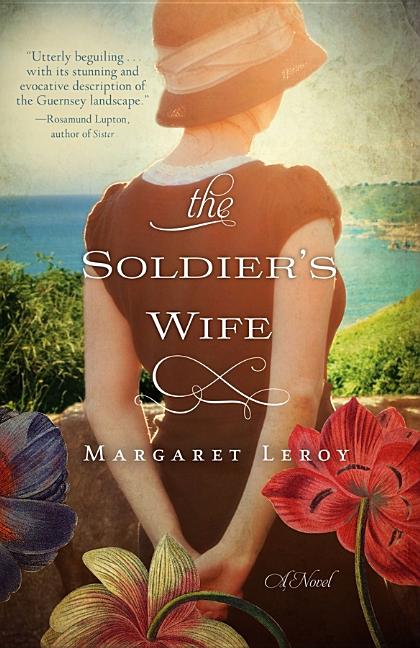
The Soldier's Wife
by Margaret Leroy
)
Shop All Audiobooks
*When you open this audiobook on Libro.fm, be sure to select Aveson as your bookstore so that your purchase supports local literacy programs and tree‑planting.
Couldn't load pickup availability
A novel full of grand passion and intensity, The Soldier's Wife asks "What would you do for your family?", "What should you do for a stranger?", and "What would you do for love?"
As World War II draws closer and closer to Guernsey, Vivienne de la Mare knows that there will be sacrifices to be made. Not just for herself, but for her two young daughters and for her mother-in-law, for whom she cares while her husband is away fighting. What she does not expect is that she will fall in love with one of the enigmatic German soldiers who take up residence in the house next door to her home. As their relationship intensifies, so do the pressures on Vivienne. Food and resources grow scant, and the restrictions placed upon the residents of the island grow with each passing week. Though Vivienne knows the perils of her love affair with Gunther, she believes that she can keep their relationship--and her family--safe. But when she becomes aware of the full brutality of the Occupation, she must decide if she is willing to risk her personal happiness for the life of a stranger.
Includes a reading group guide for book clubs.
Share
Book Details
- ISBN
- 9781401341701
- Binding
- Paperback
- Authors
- Margaret Leroy
- Publisher
- Voice
- Published Date
- June 1, 2011
- Language
- English
- Pages
- 404
- Physical Info
- 1.13 in H x 7.92 in L x 5.3 in W (0.75 lb)

Guernsey is occupied by the German army during WW11. There is a profound love affair between a deeply intelligent mother of two (who also takes care of her ailing mother) and a very caring married German officer. The twists and turns are too numerous to describe so you must read it to understand the timing and extenuating circumstances they lived through. Great Read!
With her husband gone to fight during WWII Viviene tries to leave the island of Guernsey with her 2 young daughters. Standing in line for so long to get on a boat to London unnerves her and she decides to stay. When the Occupation begins the war is finally real to her. German officers move into the abandoned house next door and she begins a love affair with Gunther that is more real than her marriage ever was. Keeping it a secret so her fellow villagers do not turn from her is difficult especially with her mother-in-law who is becoming senile living with her. After befriending a slave who sneaks away from the camp she thinks her lover had turned her in when he house is searched. Any WWII and romance fanatic will enjoy this tale of intrigue and clandestine love.
The Soldier's Wife is set during WWII on the island of Guernsey. With a German occupation being imminent, Vivienne has made the difficult decision to leave the island with her two daughters, leaving her mother-in-law, who is suffering from the early stages of dementia, with friends. When their only option is a small, crammed boat, Vivienne changes her mind, much to her older daughter's disappointment. They return to a home that has been vandalized, but try to make the best of the situation. When the inevitable occupation occurs, Vivienne is conflicted by her feelings for the German officers who have moved in next to them. She must also balance her daughter's interest in the entertainments provided by the young Germans with her worries about curfews and the feelings of the islanders. While she has a husband off fighting the Germans, their relationship was difficult at best. When she has an opportunity for affection, she must weigh her own feelings against the risks of being discovered for both her and her family. As the occupation proceeds, the introduction of laboring prisoners of war makes for even more challenging moral questions for Vivienne. What I liked best about this book is that it shows all of the shades of gray in the situation of war. There are few true enemies and few true heroes, with people trying to make the best of very difficult circumstances.
Sadly, this could have been a great book. The author captures the atmosphere of Guernsey Island -- the peaceful countryside, the changeable weather, the profusion of flowers. Especially the flowers of which there are on-going references throughout the book.The relationship of the main character with her daughters and her mother-in-law are also sensitively drawn, especially how she tries to soften but not hide the horrors of war from the girls.The basic story is how a woman, her husband off to fight in World War ll, can develop a loving relationship with a German soldier who's part of the Nazi occupation of the island. The writer even makes creditable that the couple can sustain the connection over a period of years by avoiding the fact that he's "the enemy." This is possible because he comes to her late at night and leaves in the pre-dawn; there is no true relationship beyond the comfort of sex.This makes it even plausible the way the affair ends: the deep distrust buried under all they don't talk about finally erupts over an escape from the prison work camp on the island.But, considering the book as a whole, I felt cheated by the author who skipped over what I considered vital elements in the story.(WARNING: spoiler info in the following.)First, the narrative jumps from a scene where the woman (whose marriage had been cold and sexless for years) is barely able to converse with "the enemy," although she experiences intense physical desire, to the scene where she's leading him up to her bedroom to start the affair.Yes, I can imagine what happened in between, but HEY, that's why I'm reading the book -- to see how the author handles her character's situation.In the last scene in the book it's 1946. Life on the island is back to normal; her husband survived the war but they are no longer together. The woman goes to meet one of the former German occupiers who tells her what happened to her former lover after he left the island. She receives back the book of poems she'd given him that he always carried. It's bittersweet to see how he'd written his hame below hers in the book, now blood stained from his death.The very last sentence of the book has the woman going home to embrace a little boy with the eye color and smile of her German lover.W H A T ? ? ? Was this to make the ending happy-ish? For me, it cast a spotlight back on the whole story, making glaring how shallow it was.I could accept that the love affair could be kept secret for years with no repercussions to the woman as a collaborator. But to have his child and then, as far as the author tells us, just go merrily back to her peaceful Guernsey life?I can't accept it without knowing how it happened. In some occupied countries women who consorted with the Germans were very badly treated after the war. Were the English on guernsey so forgiving? Unlike the earlier gap in the story I can't fill in what the author leaves out because I don't know, I haven't done research as she says she has about the island's occupation.If the woman didn't become an outcast in society, why not? How not? To answer this the author would have needed to pay more attention to the social life of the islanders, the mores, that underlay civil life. Had she done so, this could have been a memorable book.Conclusion: The author spend too much time evoking the aromas of Guernsey and not enough on the sociological conditions that would have grounded her story in a credible reality.

My second time reading The Soldier's Wife and I found it just as unforgettable as the first. The author pulls as back into a quickly vanishing time, reminding us of the daily deprivations that accompanied even the gentlest of occupations. Margaret Leroy's writing is lyrical and I loved the way she made nature and the Isle of Guernsey as important to the reader as were her human characters. I could truly smell the flowers, view the sea, listen to the call of blackbirds and move through Vivienne's creaking old house alongside her and her family. Leroy is a master artist, creating vivid portraits with words rather than oils. And the effect is as compelling, as visually striking. The Soldier's Wife is a reminder of life lived on a small, but powerful, scale in life-altering circumstances. I also really liked the complicated love story--I would label it a love story for grown ups--and the idea that there are few absolutes in life. All Germans were not monsters or the caricatures we see in war movies. I also enjoyed the complicated situations. What does it mean to be a collaborator? Would I have fraternized with the enemy to protect my children? Could I have resisted falling in love with someone as lonely as myself in similar circumstances? No simple situations or simple black and white answers. Which is what makes for timeless literature.Congratulations to Margaret Leroy for creating a beautiful novel that will be read and applauded for many years to come.
)