
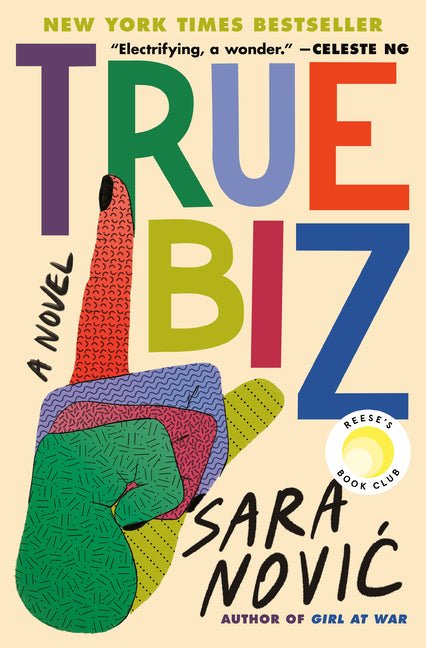
True Biz: A Reese's Book Club
 )
 )
Couldn't load pickup availability
NEW YORK TIMES BESTSELLER - REESE'S BOOK CLUB PICK - A "tender, beautiful and radiantly outraged" (The New York Times Book Review) novel that follows a year of seismic romantic, political, and familial shifts for a teacher and her students at a boarding school for the deaf, from the acclaimed author of Girl at War
"This important novel should--true biz--change minds and transform the conversation."--Maile Meloy, The New York Times Book Review (Editors' Choice)
ONE OF THE BEST BOOKS OF THE YEAR: NPR, The Washington Post, Publishers Weekly, Booklist
True biz (adj./exclamation; American Sign Language): really, seriously, definitely, real-talk
True biz? The students at the River Valley School for the Deaf just want to hook up, pass their history finals, and have politicians, doctors, and their parents stop telling them what to do with their bodies. This revelatory novel plunges readers into the halls of a residential school for the deaf, where they'll meet Charlie, a rebellious transfer student who's never met another deaf person before; Austin, the school's golden boy, whose world is rocked when his baby sister is born hearing; and February, the hearing headmistress, a CODA (child of deaf adult(s)) who is fighting to keep her school open and her marriage intact, but might not be able to do both. As a series of crises both personal and political threaten to unravel each of them, Charlie, Austin, and February find their lives inextricable from one another--and changed forever.
This is a story of sign language and lip-reading, disability and civil rights, isolation and injustice, first love and loss, and, above all, great persistence, daring, and joy. Absorbing and assured, idiosyncratic and relatable, this is an unforgettable journey into the Deaf community and a universal celebration of human connection.
Book Details
- ISBN
- 9780593241509
- Binding
- Hardcover
- Authors
- Sara Novic
- Publisher
- Random House
- Published Date
- April 5, 2022
- Language
- English
- Pages
- 400
- Physical Info
- 1.6 in H x 9.3 in L x 6.1 in W (1.45 lb)
Can’t wait to read it and etc. I just want to review it now because it's got little bit damaged on the back of the book when I paid for Brand New price!. Tsk.Will update when I finish read.


Ending felt rushed with lots of unresolved questions. The author also unnecessarily shoved in what were obviously her personal views on political and social topics, which ruined parts of the book for me. I loved learning about deaf culture and history. Mini lessons between chapters were great!
I really enjoyed this book. It was easy to read and had interesting characters and a unique plot line. My favorite part about the book was the glimpse into deaf culture and community and each of the characters unique perspectives and experiences. Exposure to different communities, ways of life, and perspectives is one of my favorite things about reading so I enjoyed it.
This book is a really good read by itself but if you want to know about Deaf culture and history and a real look at what it's like being Deaf, this is the one to read. I'm enjoying it so much and will be using much of the extra "teaching" parts in the ASL classes I teach. Not sure why I didn't come across this book a long time ago! It's gold!
Novic's characters have opened to me the world of Deaf Culture with its controversies, undercurrents, and moments of pride. I can't say I liked this book, but I learned from it.
An engaging and informative novel about the deaf community. There is much to be learned that the majority of us do not know! There are a number pages that crop up devoted to illustrating signing if you are interested. I found it slow for me to become involved, but once I was hooked, I really enjoyed it and came away wiser!
As the mother of an adult daughter, diagnosed with autism at age three, I felt a real connection with this story. While the Deaf Community is different from other groups and individuals with disabilities, I have also seen the rise of “inclusion” for all types and varieties of differences and disabilities. As a mother and an advocate for adults with Intellectual and Developmental Disabilities, I know from experience that each of us is unique and that “one size or approach does not fit all”. As parents, we do the best we can for our children becoming experts in areas that challenge them. While we jumped onto the “inclusion” wagon during our daughter’s school years, it has become apparent that as an adult she needs more support and an intentional community as part of her larger world including competitive employment would greatly enrich her life. The author did not demonize the parents as they navigate their way and do their best to support their children. When I think of my beautiful daughter, I know that she is both different in many wonderful ways, but also challenged by a disability and she knows this too. I hope that we can all support a variety of options for all people. Thanks to the author for an excellent book!
This book will forever be a very memorable piece of literature for me! Novic did an amazing job at creating an entertaining story, while also making it so educational - I learned so much about ASL and the deaf community while reading this and it was such a treat! I was also horrified to learn about some of the dark history that surrounds the deaf community (especially the cochlear implants) 🤯 I was super impressed that Novic included in between chapters some diagrams of ASL, which was super interesting, and other bits of information that were excellent ways to educate the reader on deaf culture and the fascinating history of ASL.As for the story in general, I really enjoyed it! Most of the characters were easy to root for and were very diverse. My only criticism is that February's character did not do a whole lot for me and was the most unlikeable personally. I would have rather had more time spent on the students, and furthering their character development instead of chapters being on her. But that being said, I understand and appreciate the role she had to play in the story and to add another point of view when it comes to looking at the deaf community.This was such an incredible book and I want to recommend it to absolutely everyone since it was so eye opening. Can't wait to read more from this author!
One of the things I did like about this book was the diversity shown. While it's not something I would typically read (too much profanity for my taste) it's not something I would critique the book for.As someone with vision and hearing impairments I've never learned how to use ASL, typically lipreading or having my teachers and peers use a microphone. Seeing a new perspective is something I do like to see.But I do find a few things confusing about the story, and at times rubbing me the wrong way. For instance, the lack of quotations when someone is speaking (signing in italics is okay), but sometimes the paragraphs and dialogue is weird. I tend to read more slowly and carefully as I read, which meant I needed to go back and reread a few sentences.If it is the style used, sure fine. At least make it more clear. So that it's more obvious during action beats, for instance.Another issue I had was the info dumping that occurred about deaf culture. While it's good information, I just found it mostly distracting to the story. It kept pulling me away, feeling like I wasn't part of the story. I just had trouble caring about the characters.Of course, everyone is different, and that's okay. Everyone has a unique story, but there was too much drama and stakes and not enough characters. That and the profanity made me not want to keep reading this book.
For me, it is 3.5 stars but round to 4 stars. I appreciate highly the author for giving something so relatable. Also, sharing many finer points of sign language with the audience other than myself about my culture through the story. Both hit me so well but the story was okay. Many subplots left in the air were one too many unsatisfied feelings. Especially the ending, which I disliked because of the way it turned as a climax. However, one needs to remember that the ending is to each writer’s own. I think this book deserves a good length of time with the spotlight. Who knows it might become a classic for the future deaf history class.
True Biz: A Novel by Sara Noviç is an enlightening story about the deaf, particularly deaf children. The contemporary story takes place in Colson, Ohio at River Valley School for the Deaf (RVSD).The title of the book, True Biz is an exclamation used in American Sign Language (ASL) that means really, seriously, definitely, or real talk. Students at RVSD simply want to understand the world around them, hang out with friends, and blend in. But, as with any special needs children, there are always obstacles to overcome.The story centers around two children and the headmistress of the school.Charlie, lives with her father as the result of a custody battle. Both her parents can hear, but Charlie was born deaf. When she was three years old she had surgery to install a cochlear implant, which, unfortunately didn’t work. Charlie suffers with annoying buzzing sounds and headaches. She attended public schools but became rebellious when she couldn’t understand what people were saying and had no way to communicate. When she was placed in RVSD she still couldn’t communicate because she had never learned ASL, which was how the students communicate with their teachers and one another.Austin, also a student at RVSD is deaf like his parents and grandparents. He’s a well-adjusted, popular kid and is asked to show Charlie around the school and the two form a special bond. Austin and his parents’ world become confusing when they have a new baby girl who can hear.February is headmistress of River Valley School for the Deaf. She desperately fights to keep the school running despite its threatened closure, to meet her obligations at home, and try to fulfill the needs of her aging mother. She is a CODA, an acronym that stands for a hearing child of deaf adult(s).True Biz is an unforgettable story. I learned a great deal about the deaf, their challenges and feelings of isolation. Author Sara Noviç, is deaf, so I had the assurance that she knows the loneliness and struggle for human connection. I learned about the debates surrounding deaf children: should they be equipped with a cochlear implant, learn to lip read, or learn ASL, choices that all have advantages and disadvantages. I learned that ASL is a language of concepts, that only as a last resort will a word be spelled out. Chapters are interspersed with interesting tidbits of deaf historical “cures,” remedies through the centuries, conventions to discuss deaf education, and diagrams of ASL.
What can I say but "WOW!" I had no idea what to expect when I picked up this book. I was captivated from the first page. The writing style held my interest, while teaching me about deaf culture and broadening my perspective. Because the story unfolds from (primarily) three different viewpoints, it brings the entire picture together. So many challenges to be solved - and not all of them are, but after reading this book, I have a much greater empathy for the deaf community and their struggles and triumphs. Although there are many themes woven through the characters' stories, my main takeaway is that we are all differently abled in some way. This diversity makes us a beautiful collective and we should celebrate those differences, not try to erase or homogenize them. Everyone - especially educators - should read this book.
This novel was compelling in many ways. Not only was it a story that kept you intrigued, but it provided historical information that coincided with the book. This was a deep look into the life of the Deaf community. I did not like that the author refrained from using quotation marks for spoken statements, but perhaps that had a purpose of it own. I loved that the chapter titles used ASL to distinguish whose perspective the chapter was from, rather than just names. The ending of the book was not all that I had hoped for as a reader. However, I believe the author choosing to end in such a way was more powerful and thought-provoking.
I think #ownvoices books have to balance whether they want to be written for their own community without thought to translating the experience to others, or written to explain their experiences to others and risk not being for the community they represent. I feel like this book is primarily written to explain a good deal of justified anger and pain that many in the deaf community already understand, but I do think it does a good job of including the deaf as well.The story is about a deaf school and the students and teachers who are a part of it. The characters represent a wide variety of different experiences that deaf individuals have, including those with and without cochlear implants, those who are taught sign language and those who are not, those who learn ASL and those who learn BASL, and those with supportive families and those without. It even includes CODAs and many different hearing characters with different approaches to interacting with the deaf community. Everyone can find a character that looks like them.I also think this book is masterful at explaining the myriad intersecting issues that arise in the deaf community. Should children be given cochlear implants before they are able to have a say? How should language be taught? What about intersectional issues involving race and sexuality? How are deaf females treated differently than deaf males? Also, just because someone is deaf doesn’t mean they don’t also experience things that every other teenager or parent also experiences. They still want to be the best parents, they still lust after their chosen sex, they still make foolish decisions under duress. And when pressed because no one will listen, they get to react with justified anger.I think the most profound thing is that it’s the hearing characters who have the most trouble listening.
In American Sign Language (ASL) true biz means seriously, no kidding, or real talk. Sara Novic’s novel True Biz shows the somber side of deafness following three characters, Deaf and hearing, as the author shows their lives during a pivotal year at the River Valley School for the Deaf. Her choice of characters and hearing issues are typical to the Deaf community.Charlie was born deaf, but instead of learning ASL and giving their daughter a language, her mother pushes for a cochlear implant, that doesn’t work. Charlie’s dad eventually realizes their mistake and enrolls his daughter at River Valley as well as take night classes with his daughter in ASL.Charlie is typical of most deaf children born to hearing parents. Austin, on the other hand, is DEAF royalty coming from a family where deafness is generational. This changes when his baby sister is born hearing. [Note: This is devastating for a deaf couple because they want their child to be just like them.]Finally, we meet February, a CODA child born to Deaf parents. February is the headmistress of River Valley fighting desperately to keep her school opened as she encounters problems at home, death of her mom, and locating the whereabouts of three of her students.True Biz is a wonderful source to learn about Deaf culture and the reaction people have toward hearing loss. We also see how educators view teaching the deaf. One school of thought teaches that Deaf children shouldn’t learn ASL. It exposes deaf children only to English with an expectation they learn to lip read, get a cochlear implant, and be mainstreamed into the hearing population. The other side of the coin suggests a Deaf education where children learn ASL providing them with a language they can easily understand and be able to communicate in.My only criticism of Novic’s novel is she doesn’t use quotation marks to inform readers that an English-speaking character is talking. She uses italics when a Deaf person signs, but English conversation is not noted making some sections of the book hard to follow forcing the reader to re-read for comprehension.With that said, I recommend True Biz to any student of Deaf culture and to anyone wanting to understand the trials of their deaf and hard-of-hearing friends and family.
True Biz took me to a new place but/and the story herein is bigger than "a novel about kids at a boarding school for the deaf.' True Biz, like any big, beautiful, and strong novel takes the reader into a new world peopled by characters that reveal themselves in thought andactions, and grow inside the reader as well as inside the story. This is a story about relationships, hurts and angers, loves and loyalties -- about thriving within our worlds. Shakespeare calls our lives 'the stuff which dreams are made upon' and Nović captures these worlds with love, with righteous anger, and with passion. This novel is hard to put down.
This is one of my top reads this year! Somehow I just read a heartwarming and heartbreaking story with compelling characters both deaf and hearing while I learned SO MUCH about the deaf community. I think sometimes when we think of the deaf, we just think of people with a disability who use sign language and give it no other thought, at least that was true for myself. I am so glad to be so much more educated on the deaf community, the controversy of Cochlear implants, the history of wanting to “fix” deaf people to make them hearing, and so so much more. And while I learned all of this, we followed sweet Charlie, who at age 15 has very little ability to communicate due to not being allowed to learn ASL to rely on her implant which did not work for her at all. I don’t want to say too much more because I just want you to read it and learn and love it like I did!
Interesting novel. This story is about the deaf culture. The main characters are February the head mistress of a deaf school. Charlie, a student, whose mother has never accepted her daughter's deafness. Austin, another student, who comes from generations of deaf relatives. You understand, a little, how deafness is part of all these characters lives. February is not deaf but her mother is deaf. Charlie's parens both can hear. While Austin has only one parent who is deaf. Whereas February and Austin are fluent in ASL, Charlie has never learned ASL and has had to cope with cochlear implants and lip reading all her life. The character of February is amazing. She has devoted her life to the deaf community. She is such a devoted daughter even if she is not as devoted to her wife. Charlie is anew student to the deaf school. She begins to blossom as she learns to communicate. She is a tough character to like but she is a fighter which is how she has survived. Austin seems like a genuine nice young man. He comes from a family that is revered in the deaf community but his world is rocked when his mother gives birth to a hearing child. This novel gets a little dark when you realize how little say some of these kids have in their deafness. There's also a bit of deaf history thrown into the book which was so enlightening.
I am an ASL Interpreter and worked at a Deaf residential school so the story was plausible. I felt like I was back at the Deaf school I worked in along with privileged scenarios I witnessed while interpreting in the community. It also confirmed how one breach of confidentiality as an interpreter can snowball as it leaks. Just don't if you're an interpreter reading this. Ethics are TRUE BIZ. It's great to see a more current book for ASL and Deaf studies students to read other than those in my outdated library.The beginning moved slowly for me as the author set the stage. I wondered how readers who had no background in the Deaf community were following it. But it picked up speed and became riveting. Couldn't put it down. It is tragic seeing the Deaf schools close and the list the author included at the end of the book is heartbreaking. As are the genocide attempts toward the Deaf Community as experienced by the characters' stories.
This exquisitely written story, about a Deaf teenage girl and her world, touches on her family life, her friends and teachers at school and her friends in the community at large. I love that the story has believable characters of different ages and genders. I loved EVERYTHING about the story!The plot is exciting, which is a real plus. Mixed into the narrative are stories of the history of Deaf people and how they have been perceived, educated and treated by those who are hearing. The story line together with the historic background provide a clear picture of the importance of Deaf schools, why many of them have closed and how this impacts Deaf students.Each chapter heading begins with a sign language hand shape. At least eight charts inserted throughout the text explain various attributes of American Sign Language (ASL) and give illustrated examples.Another aspect of ASL, which I encountered for the first time in this book, was the placement of dialogue on the page. One speaker's words are on the left side of the page and below that the next voice speaks from the right side of the same page. This mirrors the way sign language uses space to refer to different subjects.I'm studying beginning sign language at a local college. On so many levels, reading this book was helpful to me!

