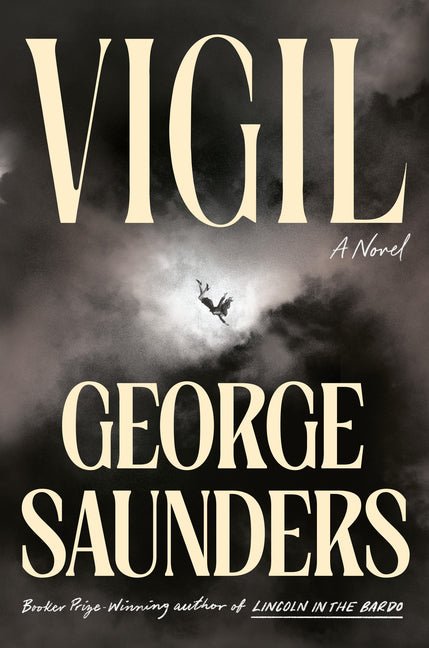
Vigil
by George Saunders
)
Shop All Audiobooks
*When you open this audiobook on Libro.fm, be sure to select Aveson as your bookstore so that your purchase supports local literacy programs and tree‑planting.
Couldn't load pickup availability
An electric novel from the #1 New York Times bestselling, Booker Prize-winning author of Lincoln in the Bardo, taking place at the bedside of an oil company CEO in the twilight hours of his life as he is ferried from this world into the next
Not for the first time, Jill "Doll" Blaine finds herself hurtling toward earth, reconstituting as she falls, right down to her favorite black pumps. She plummets towards her newest charge, yet another soul she must usher into the afterlife, and lands headfirst in the circular drive of his ornate mansion.
She has performed this sacred duty 343 times since her own death. Her charges, as a rule, have been greatly comforted in their final moments. But this charge, she soon discovers, isn't like the others. The powerful K. J. Boone will not be consoled, because he has nothing to regret. He lived a big, bold, epic life, and the world is better for it. Isn't it?
Vigil transports us, careening, through the wild final evening of a complicated man. Visitors begin to arrive (worldly and otherworldly, alive and dead), clamoring for a reckoning. Birds swarm the dying man's room; a black calf grazes on the love seat; a man from a distant, drought-ravaged village materializes; two oil-business cronies from decades past show up with chilling plans for Boone's postdeath future.
With the wisdom, playfulness, and explosive imagination we've come to expect, George Saunders takes on the gravest issues of our time--the menace of corporate greed, the toll of capitalism, the environmental perils of progress--and, in the process, spins a tale that encompasses life and death, good and evil, and the thorny question of absolution.
Share
Book Details
ISBN:
9780525509622
EAN:
9780525509622
Binding:
Hardcover
Pages:
192
Authors:
George Saunders
Publisher:
Random House

An exploration of moral and amoral behavior in myself and others. The protagonist invites me to act in life but with suspended judgment of others because we are all inevitably the way we are. The author’s devices immediately engaged me in a dimension of human life to which I have little access. Yet after finishing the story, I feel I have access in a new way. The Way of Comforting; or in other words the Way of Compassion.
Interesting for some different reasons
Amazing. Does not disappoint for any fans of his.
The concept of this novel is strikingly original and I wanted to love it, but it’s flawed in so many ways. The story is well-intentioned but pontificates too much. There are superfluous characters, so many it becomes annoying. Could have been a great book.
I must say I was quite impressed with the fact that a novel like Vigil was the #1 NYT Bestseller. It definitely falls out of the the overlapping section of a Venn diagram where most mainstream bestsellers like those of James Patterson land. It is a literate, thought provoking book that seems more akin to be a mandated text read in philosophy and theology classes rather than in mainstream pop literature. In order to really review the book I have to warn of SPOILER ALERTS although they are relatively few but critical to an incisive analysis. Maybe it was the remnants of my Jesuit education at Fordham College and St. John's School of Law, but I was torn between the quintessential point of the book-- what does it all mean? The premise is deceptively simple: an oil magnate is on his deathbed and there are a number of spirits waiting for him to die. He was a rags to riches phenomenon whose ends justified the means and thus was a controversial figure. Although not spelled out in detail, his journey included not only the seven "deadlies" it seems but a detrimental impact on global climate. A spirit named Jill who was once a living person is now in a state of "elevation" and like a modern day Charon, the Ferryman (let's be politically correct- "Ferryperson") is sent to help him pass over. Of course, most of the people Jill has handled has recognized their failings, limitations, mistakes and repent at least in conscience. Despite her urging and the appearance of other spirits who try to make him see the error of his ways in life, he steadfastly refuses to give in and it is not until we see some sort of repentance (almost as a deus ex machina "Scrooge" scenario) after he dies and his spirit is stripped of its body including his consciousness. My issue with the novel is that I cannot accept the ending. According to the author, we are who we are, born and then dealt a series of occurrences and end up who we have become. "Good" and "Bad" are just personas or costumes that we wear. We are products of a flawed system and therefore should not be judged by our actions in life. But if we follow his philosophical point of view, we are all deterministic bio puppets of a faulty machine. There is no moral proactive reacting and the meaning of justice vanishes. If we do not have some critical thinking on our deathbeds and at realize and take accountability for mistakes, failings and errors of judgment, then we are throwing out Stoicism, Buddhism, Christianity, free will, etc. ad nauseam. It is just a novel about determinism. If consciousness is only realized at the moment of death, there is no "elevation" but rather an autopsy with no justifiable cause of death. That being said, I certainly enjoyed the book because it got me to thinking.
)